
Equity Capital Raising: A Strategic Guide to Architecting Corporate Growth in 2026

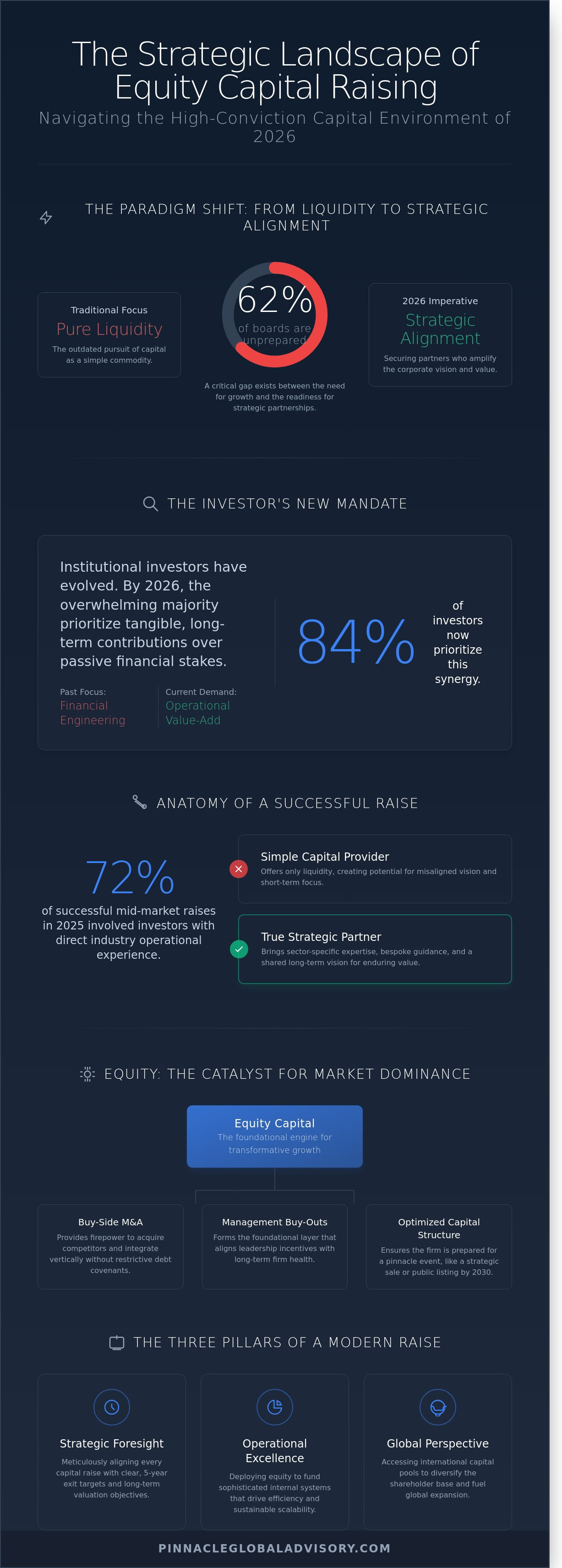
In the evolving financial architecture of 2026, the traditional pursuit of liquidity has been superseded by a demand for strategic alignment that 62% of executive boards are currently unprepared to meet, according to data from the 2024 Global Private Equity Report. You recognise that while equity capital raising is the essential fuel for expansion, the true risk lies not in the scarcity of funds but in the potential erosion of your corporate vision through misaligned partnerships. It's a sophisticated challenge to secure the summit of your industry without sacrificing the foundational values that built your enterprise. You've likely felt the tension between the need for rapid scaling and the fear of excessive dilution that can cloud a leader's long-term perspective.
By reading this guide, you'll master these complexities through a framework designed for high-growth enterprises and visionary leaders. We'll provide the strategic foresight needed to protect against misalignment while ensuring your trajectory remains steady and purposeful. We'll examine the bespoke methods for engaging global investor networks and the precise steps required to optimise your valuation for a future secondary sale or a transformative exit. This approach ensures that every capital injection is not just a transaction but a pillar of your enduring corporate legacy.
Key Takeaways
Navigate the shifting landscape of 2026 by aligning your corporate vision with high-conviction capital designed to fuel transformative global expansion.
Master the art of architecting a capital raise by identifying sophisticated partners in private equity and venture capital who offer strategic value far beyond simple liquidity.
Optimise your capital stack by expertly balancing the nuances of dilution and repayment obligations, ensuring that equity capital raising serves as a catalyst for long-term stability.
Map the trajectory of a successful transition through meticulous preparation, focusing on the strategic alignment of financials, valuation, and a compelling corporate narrative.
Discover why bespoke advisory is the definitive factor in reaching the summit of corporate excellence, moving beyond transactional brokerage to achieve visionary results.
The Strategic Landscape of Equity Capital Raising in 2026
Equity capital raising represents the deliberate issuance of shares to catalyse transformative growth within a high-performing enterprise. It's not merely a transaction; it's a strategic architectural choice. By 2026, the global financial environment has transitioned toward a model of sophisticated, high-conviction capital. Reports from the first quarter of 2026 indicate that 84% of institutional investors now prioritize "operational value-add" over pure financial engineering. Investors no longer seek mere participation. They demand deep strategic alignment between a founder's long-term vision and their own investment trajectory. This synergy ensures that every dollar of capital injected serves as a precise instrument for scaling. Equity remains the undisputed cornerstone of the capital stack for high-growth firms because it provides the permanent base required to weather market volatility while pursuing aggressive expansion.
Understanding the broader Equity Capital Markets Overview is essential for any C-suite executive looking to master this terrain. In the current landscape, the ability to articulate a clear path to market leadership is what separates elite firms from the rest. This doesn't just involve presenting balance sheets; it requires a narrative of mastery and vision. When a company chooses to raise equity, it's inviting partners into the inner sanctum of its corporate journey, making the selection of those partners a critical decision for the firm's future pinnacle.
The Evolution of Private Equity and Venture Capital
The landscape of private equity and venture capital has matured significantly. By early 2026, the distinction between a capital provider and a strategic partner has become absolute. Investors now prioritise sector-specific expertise, offering bespoke guidance that transcends traditional financial oversight. This shift means that 72% of successful mid-market raises in 2025 involved investors with direct industry operational experience. Equity financing is the exchange of ownership for growth capital to reach a corporate summit. This evolution reflects a broader trend where the focus has shifted from short-term liquidity to the creation of enduring enterprise value and global reach.
Equity as a Catalyst for M&A and Management Buy-Outs
For leaders targeting market dominance, equity capital raising acts as the primary engine for buy-side M&A strategies. It provides the necessary firepower to acquire competitors or integrate vertically without the restrictive covenants often found in debt instruments. This flexibility is vital in structuring management buy-outs, where equity serves as the foundational layer that aligns leadership's incentives with the firm's long-term health. Elite architects of success maintain strategic foresight by planning every raise with a definitive exit or transition in mind. They ensure the capital structure remains optimised for the eventual pinnacle of the corporate journey, whether that involves a public listing or a strategic sale by the year 2030.
Strategic Foresight: Aligning current raises with 5-year exit targets.
Operational Excellence: Using equity to fund internal systems that drive efficiency.
Global Perspective: Accessing international capital pools to diversify the shareholder base.
Architecting the Capital Raise: Private Equity, VC, and Secondary Markets
The architecture of a successful equity capital raising initiative requires more than just a surplus of capital; it demands a precise alignment between a firm's current operational maturity and its long-term strategic foresight. As we move toward 2026, the distinction between capital sources has become increasingly specialised. Selecting the wrong partner can lead to a divergence in vision that compromises the corporate trajectory. Leaders must evaluate potential investors based on their ability to offer Global reach and sector-specific operational support, ensuring that the partnership extends beyond the initial injection of liquidity.
Institutional Equity: Venture Capital vs. Private Equity
The choice between Venture Capital (VC) and Private Equity (PE) is fundamentally a choice of institutional purpose. While VC firms prioritise rapid scaling and technological disruption, PE partners typically focus on operational excellence and the stabilisation of cash flows in mature enterprises. Identifying a lead investor requires a meticulous assessment of their Global network and their history of navigating complex market terrains. A bespoke capital raise in 2026 often hinges on the lead investor's ability to provide more than just a balance sheet; they must act as a strategic architect of the firm's future state. Success depends on finding partners who possess the discipline to support a long-term vision without imposing short-term volatility.
The Power of Secondary Market Transactions
Secondary markets have evolved into a sophisticated tool for managing stakeholder expectations without the immediate pressure of a public offering. These transactions allow early investors and long-tenured employees to realise value, which effectively cleans up the cap table and aligns the interests of new, high-conviction institutional backers. For pre-IPO companies, leveraging Secondary Market Transactions provides a strategic advantage by reducing the "liquidity discount" often associated with private firms. A 2024 report by Preqin indicated that secondary market transaction volumes reached $112 billion, marking a 4% increase over the previous year. This trend suggests that maintaining a lean, professional cap table is essential for firms aiming for the pinnacle of their industry.
Bespoke Investor Networks
The 2026 landscape is increasingly defined by the rise of family offices and sovereign wealth funds. There are now over 15,000 family offices globally, each seeking direct investment opportunities that offer more stability than traditional public markets. Integrating sophisticated Capital-Raising Strategies into the corporate DNA ensures that the firm remains resilient against market fluctuations. A curated approach to investor outreach is far superior to a scattergun method; it fosters a sense of exclusivity and strategic partnership.
Family Offices: Provide patient, long-term capital with a focus on generational stability.
Sovereign Wealth Funds: Offer unparalleled Global connectivity and massive scale for transformative projects.
Strategic Corporates: Deliver immediate market access and synergy-driven growth.
If your organisation is prepared to ascend to the next level of corporate excellence, securing a partner with a Global perspective is the first step toward a transformative outcome.
Equity vs. Debt: Balancing Diligence and Liquidity in the Capital Stack
Architecting a robust capital stack requires a nuanced understanding of how different financial instruments interact with a firm's long-term trajectory. While many executives view the choice between equity and debt as a simple binary, the most successful global enterprises treat it as a balancing act of risk, control, and agility. Equity capital raising serves as the bedrock of this structure, providing the essential "permanent" capital that allows a leadership team to pursue transformative goals without the looming pressure of monthly interest payments or restrictive bank covenants.
The Cost of Capital: A Strategic Comparison
The primary objection to equity is its perceived high cost, as giving away a 20% or 30% stake in a high-growth firm feels expensive compared to a 7% bank loan. This perspective often overlooks the hidden costs of debt, which include rigid repayment schedules and collateral requirements that can paralyse a company during market shifts. Equity provides a foundation for vision, while debt provides the scaffolding for execution. When a firm targets a massive expansion, such as a $40 million entry into a new geographic territory, the flexibility of equity is indispensable. It doesn't just fund the move; it provides the psychological and financial breathing room to navigate the inevitable challenges of scaling.
Hybrid Solutions: Mezzanine and Convertible Instruments
In environments where valuation remains a point of contention, hybrid instruments offer a sophisticated bridge. Convertible notes and mezzanine finance have become essential tools for leaders who want to secure growth capital while deferring the final valuation of their enterprise. These instruments often sit between senior debt and common equity, providing a "best of both worlds" scenario. By utilising these structures, a firm can avoid immediate dilution during a volatile period, allowing the business to hit its next set of performance milestones before the debt converts into equity. This strategic foresight ensures that when the conversion happens, it's at a valuation that reflects the true pinnacle of the company's achievements.
Debt Advisory as a Strategic Tool
A truly integrated approach to corporate finance recognises that equity shouldn't be used for everything. Utilising asset finance or invoice finance to cover operational needs is a hallmark of operational excellence. By engaging in professional Debt Advisory, a business can unlock liquidity from its own balance sheet, preserving its equity for high-stakes equity capital raising rounds that fuel genuine innovation. This alignment ensures that the capital stack isn't just a collection of loans and shares, but a carefully engineered engine designed to support a steady, unstoppable ascent in the global market.
The Trajectory to Success: Navigating the Equity Lifecycle
The journey of equity capital raising is a disciplined ascent that requires both technical precision and visionary storytelling. It's not a mere transaction; it's a transformative milestone that redefines a firm's market position. Success in 2026 depends on a leader's ability to move beyond reactive financing toward a proactive, Global strategy. This process begins long before the first meeting, rooted in a rigorous preparation phase that aligns internal capabilities with external investor expectations.
Valuation and Strategic Narrative
Precision in valuation is non-negotiable. While traditional models rely on historical multiples, we employ Strategic Foresight to articulate a value-based narrative that justifies a premium. Investors in 2026 aren't just buying cash flow; they're investing in a company's ability to master future market shifts. By constructing a bespoke investment memorandum, we speak the language of elite partners. This document doesn't just list assets. It details the strategic pillars that ensure long-term stability and growth. A 2024 McKinsey report indicated that companies with a clearly articulated "future-ready" narrative secured valuations 22% higher than their peers. We ensure your narrative reflects that level of mastery.
The Due Diligence Summit
We view due diligence as a summit where operational excellence is put to the ultimate test. It's a rigorous examination of financial, legal, and operational integrity. Data from 2025 suggests that 38% of mid-market deals stalled because of fragmented data rooms or unresolved compliance issues. To avoid these pitfalls, we treat the process as a tool for transparency. A well-managed data room serves as a testament to your corporate discipline. It's about demonstrating that your internal systems are as robust as your market ambitions. This phase requires a boardroom briefing mindset, where every query is met with documented evidence and strategic confidence.
Closing and Post-Transaction Alignment
The final phase is where the vision meets reality. Negotiating terms requires a delicate balance; you must protect corporate control while providing the incentives that elite investors demand. It's about creating a high-stakes partnership that benefits all stakeholders. Once the deal is sealed, the focus shifts immediately to post-transaction alignment. The new capital must be deployed toward the agreed trajectory without delay. This involves integrating investor expertise and maintaining a steady cadence of communication. True success is measured by how quickly the capital is converted into measurable growth. To ensure your firm is prepared for this level of execution, you can architect your corporate ascent with our specialised guidance.
Strategic Foresight: Why Bespoke Advisory Defines the Pinnacle
Mid-market and high-growth enterprises often encounter a glass ceiling when relying on high-volume, transactional brokers. These entities frequently focus on the immediate fee rather than the long-term capital structure. Achieving a successful equity capital raising round in 2026 demands a sophisticated architecture that aligns a firm’s 10-year vision with the immediate requirements of global institutional investors. Pinnacle Global Advisory serves as the catalyst for this transformation, moving beyond simple transactions to engineer sustainable growth through meticulous Global Strategic planning.
The Boutique Advantage in Global Finance
High-stakes transitions require a level of discretion that large, bureaucratic institutions often struggle to maintain. When a firm seeks to scale, they don't just need a process; they need a partnership. Our firm operates as an Elite Architect, ensuring that senior-level attention is the standard rather than the exception. While traditional firms might delegate execution to junior analysts, we prioritise the nuanced strategic foresight required to bridge the gap between local ambition and global capital. This distinction is vital; a process is a checklist, whereas a partnership is a shared commitment to the summit.
Our bespoke framework ensures that every deal reflects the unique DNA of the business. By 2026, data suggests that approximately 72% of successful mid-market exits will be driven by advisors who provide this level of high-touch, integrated support. We leverage a Global network of private equity, family offices, and sovereign wealth funds to ensure your transition is not just funded, but strategically positioned for the next decade of operational excellence. This Global reach allows us to find the specific "alignment" between your vision and the right investor profile.
Your Summit Awaits: Taking the Next Step
The trajectory toward a successful capital event starts long before the first pitch deck is drafted. Early engagement in the equity capital raisin lifecycle allows for the identification of structural gaps that could otherwise devalue a firm during due diligence. Industry benchmarks indicate that firms starting their preparation 12 to 18 months in advance achieve valuations up to 25% higher than those who rush to market. Initiating a confidential strategic review, often supported by fractional CFO services provides the necessary runway to optimise your internal governance and financial reporting.
We invite you to begin this journey with a partner who understands the complex terrain of international finance. It's time to ensure your corporate vision is supported by the elite-tier capital it deserves. Your organisation’s potential shouldn't be limited by standard brokerage models. Instead, it should be defined by the precision of a bespoke strategy designed for the highest level of corporate achievement.
Contact Pinnacle Global Advisory for a bespoke strategic consultation and define your path to the summit.
Mastering the Strategic Summit of 2026
As the global corporate landscape evolves toward 2026, the mastery of capital structures becomes a defining trait of industry leaders. Success in this era demands more than just liquidity; it requires the precise alignment of vision and execution across the equity lifecycle. By prioritising the nuances of private equity and navigating the complexities of secondary markets, organisations can secure a trajectory that transcends mere survival. Effective equity capital raising isn't a transactional event but a transformative process that balances diligence with long-term ambition.
Pinnacle Global Advisory serves as your elite architect in this journey. Our boutique advisory combines a global reach with deep specialisation in complex MBOs and secondary market transactions. We operate on a success-based partnership model, ensuring our goals are perfectly synchronised with your own. Whether you're navigating a high-stakes transition or scaling toward a new summit, our strategic foresight provides the clarity needed to lead with confidence. Partner with Pinnacle Global Advisory to architect your next capital raise and ensure your business reaches its rightful position at the top of the market. The path to the pinnacle is rarely linear, but it's always navigable with the right partner at your side.
Frequently Asked Questions
What is the difference between equity capital raising and debt financing?
Equity capital raising involves exchanging ownership shares for capital instead of assuming a repayment obligation. While debt requires regular interest payments, equity provides permanent capital that strengthens the balance sheet. Data from the British Business Bank's 2023 report shows equity finance reached £16.7 billion in the UK. It's a strategic choice for firms prioritising long term stability over immediate cash outflows.
How much equity should a founder expect to give up in a growth round?
Founders should expect to relinquish between 15% and 25% of their ownership during a standard equity capital raising growth round. This dilution is a calculated step toward reaching the next summit of corporate expansion. According to Carta’s 2024 benchmarks, the median dilution for Series B rounds currently sits at 18.2%. This capital infusion allows leadership to scale operations while maintaining the strategic alignment necessary for global market dominance.
What are secondary market transactions and how do they benefit shareholders?
Secondary market transactions are the sale of existing shares from one investor to another without the company issuing new stock. They benefit shareholders by providing liquidity before a formal exit event like an IPO or acquisition. Global secondary market volume reached $112 billion in 2023. This mechanism allows early backers to realise value while new institutional partners join the firm's growth trajectory.
How long does the equity capital raising process typically take for mid-market firms?
The timeline for equity capital raising typically spans 6 to 9 months for mid-market organisations. This period includes the preparation of bespoke investment materials, investor roadshows, and the final due diligence phase. Industry data from the ICAEW indicates that the preparation stage alone requires 8 to 12 weeks of focused effort. It's a disciplined process that ensures the firm is positioned for a successful and transformative capital event.
What metrics do sophisticated investors look for in 2026?
Sophisticated investors in 2026 focus on a Rule of 40 score exceeding 40% and a Net Revenue Retention rate above 110%. These metrics demonstrate a firm's ability to balance aggressive growth with operational excellence. Gartner’s 2025 financial forecasts suggest that 75% of private equity firms now require specific ESG-linked performance data. Investors seek companies that show a clear path to the pinnacle of their respective industries through sustainable practices, often seeking the guidance of a [regenerative business mentor](https://janninebarron.com) to move beyond extractive growth toward nature-aligned success.
Can equity capital raising be used to fund a management buy-out (MBO)?
Equity capital raising is frequently used to facilitate a Management Buy-Out by providing the bridge capital management needs to acquire the company. This structure often pairs the internal team with a private equity partner to ensure a seamless transition. The 2024 European MBO Report confirms that equity-backed buyouts represent 62% of mid-market divestments. It's a powerful tool for leaders looking to take full control of their firm's future.
How does a corporate finance advisor help in the valuation process?
A corporate finance advisor optimises the valuation process by utilising Discounted Cash Flow models and comparable company analysis to highlight a firm’s unique value proposition. They bridge the gap between financial data and strategic foresight. Research from Deloitte indicates that advised deals often secure valuations 20% higher than those without professional guidance. This expertise ensures the firm's trajectory is accurately reflected in the final deal terms.
Is equity financing subject to specific regulations in the UK and Australia?
Equity financing is strictly regulated by the Financial Services and Markets Act 2000 in the UK and the Corporations Act 2001 in Australia. These laws mandate high levels of transparency and disclosure to protect all participating parties. In 2023, ASIC noted that 95% of Australian equity raises utilised Section 708 exemptions for sophisticated investors. Adhering to these global standards ensures the integrity of the capital raise and builds long term trust.


Comments