
The Strategic Cost of Acquiring a Business in the UK: A 2026 Guide for Corporate Leaders

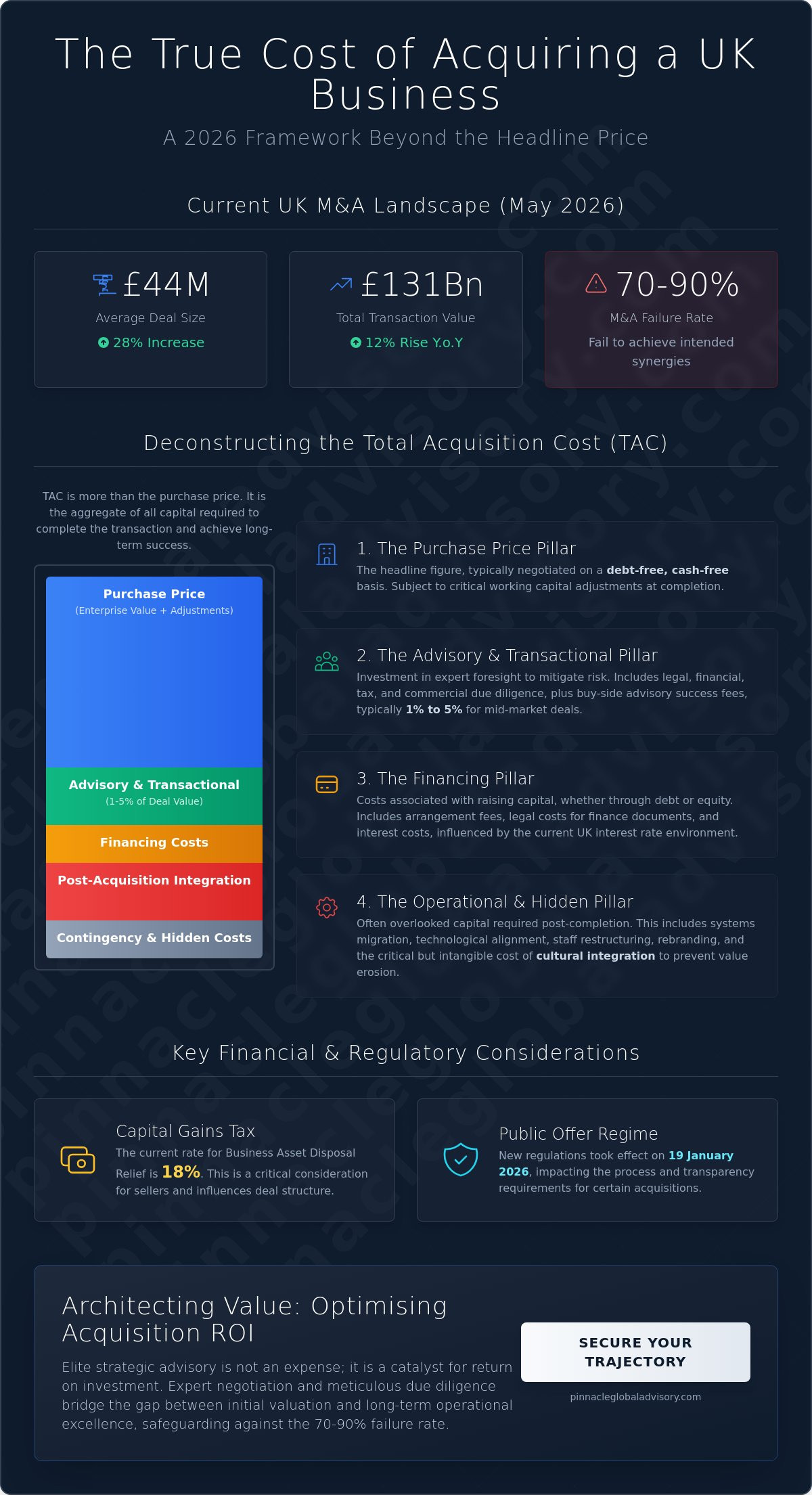
If 70 per cent to 90 per cent of mergers and acquisitions fail to achieve their intended synergies, is the true price of your expansion hidden beneath the surface of the balance sheet? You're likely aware that the sticker price is merely the starting point of a complex ascent, yet it's often the unexpected costs emerging late in due diligence that disrupt a promising trajectory. Calculating the total cost of acquiring a business UK in 2026 requires a sophisticated understanding of a landscape where the average deal size has climbed 28 per cent to £44 million, according to Financier Worldwide data from May 2026.
We'll provide a transparent budget framework to ensure your capital structure remains resilient and your integration is seamless. You'll gain a definitive breakdown of the current 18 per cent Capital Gains Tax rate for Business Asset Disposal Relief and the implications of the public offer regime that took effect on 19 January 2026. This analysis explores the direct, indirect, and strategic pillars of UK acquisitions to align your vision with a summit of sustained growth.
Key Takeaways
Distinguish between the headline purchase price and the Total Acquisition Cost (TAC) to ensure your corporate trajectory doesn't deviate from its intended summit.
Gain a comprehensive understanding of the total cost of acquiring a business UK by integrating professional advisory fees, bespoke due diligence, and the latest 2026 tax requirements.
Architect a resilient capital structure by navigating the nuances of equity capital raising and debt advisory whilst managing the current UK interest rate environment.
Safeguard against post-acquisition value erosion by prioritising the often-overlooked costs of cultural integration and technological alignment.
Discover how elite strategic advisory acts as a catalyst for ROI, using expert negotiation to bridge the gap between initial valuation and long-term operational excellence.
Beyond the Purchase Price: Redefining the Cost of Acquiring a Business in the UK
Whilst many corporate leaders focus on the headline figure presented in a Letter of Intent, the true cost of acquiring a business UK is a multifaceted equation that dictates your firm’s future stability. In May 2026, the market is defined by a flight to quality; the average deal size has surged by 28 per cent to £44 million according to Financier Worldwide. This trend suggests that whilst deal volumes have moderated, the capital commitment required for each successful transaction is intensifying. We define the Total Acquisition Cost (TAC) as the aggregate of the purchase price, the cost of professional alignment, and the capital required to master the post-merger terrain.
Viewing these expenditures through the lens of a Strategic Trajectory transforms a simple expense into a calculated investment in future scale. It's the price of entry to a new summit of market dominance. The 2026 UK landscape remains remarkably resilient amongst global fluctuations, with total transaction values rising 12 per cent to £131 billion over the past year. To navigate this environment, leaders must categorise costs into three strategic pillars:
Transactional: The immediate capital exchange for equity or assets.
Advisory: The investment in elite foresight to mitigate risk and ensure regulatory compliance.
Operational: The capital required for systems migration and cultural alignment during the integration phase.
Understanding the nuances of Mergers and acquisitions (M&A) is essential for any executive looking to expand their footprint without eroding shareholder value. It's about ensuring that every pound spent moves the strategic narrative forward.
Enterprise Value vs. Equity Value in the UK Market
In the UK, most mid-market transactions are negotiated on a debt-free, cash-free basis. This means the final cheque written at completion often differs significantly from the initial offer. Working capital adjustments play a pivotal role here; if the target's current assets don't meet an agreed-upon "peg" at the moment of transfer, the acquisition cost shifts. Enterprise Value serves as the comprehensive valuation of the business, encompassing all sources of capital including debt and equity.
The Strategic Premium: When to Pay Above Market Rate
Paying a premium for a favourite target in high-growth sectors like green technology or AI is often a visionary move rather than an overpayment. These premiums are justified through transformative synergies and rapid market share expansion that organic growth cannot match. The cost of missed opportunity is often far higher than the premium itself. Waiting for a "perfect" valuation can result in a competitor reaching the summit first, leaving your organisation to navigate a much more difficult terrain later.
The Anatomy of Transactional Costs: Direct and Indirect Expenditure
Mastering the terrain of a UK acquisition requires a granular understanding of the capital outflows that occur long before the first day of new ownership. These expenditures, often categorised by HMRC as incidental costs of acquisition, are essential for securing the integrity of the deal. The cost of acquiring a business UK is not merely the sum on the Share Purchase Agreement; it includes the vital investment in professional alignment and regulatory compliance. In the current 2026 market, where investors are prioritising fewer, higher-conviction deals, the precision of these transactional costs often dictates the success of the entire corporate trajectory.
Engaging an elite buy-side m&a advisory team provides the strategic foresight necessary to navigate complex negotiations. For mid-market transactions between £10 million and £50 million, success fees generally range from 1 per cent to 5 per cent. These fees reflect the value of a partner who acts as a high-status peer to your leadership, ensuring that every strategic pillar is expertly managed. Partnering with a Global strategic advisor ensures these direct and indirect costs are managed with the poise your board expects.
Bespoke Due Diligence: Investing in Risk Mitigation
Financial due diligence is the bedrock of any successful acquisition, but the 2026 landscape demands a broader scope. ESG (Environmental, Social, and Governance) and cyber-security audits have become non-negotiable for visionary leaders. Whilst a bespoke audit may require an upfront investment of £50,000, its true value is quantified when it prevents a £5 million mistake, such as an undisclosed data breach liability or a failure to meet the latest corporate transparency standards. This disciplined approach to due diligence ensures your organisation doesn't inherit unforeseen obstacles on its path to the summit.
Legal and Statutory Costs in the UK
The distinction between share and asset purchases carries significant fiscal weight. Stamp Duty on electronic share purchases remains at 0.5 per cent of the transaction value. On a £44 million average deal, this represents a £220,000 unavoidable cost that must be integrated into your initial budget framework. Beyond tax, the cost of drafting robust Share Purchase Agreements (SPA) and Disclosure Letters is a vital investment in long-term stability. You should also plan for VAT on professional fees; whilst often recoverable for VAT-registered entities, it requires careful cash flow management to ensure it doesn't hinder your immediate operational excellence.
Regulatory filing fees also play a role, particularly for transactions that trigger a review by the Competition and Markets Authority (CMA). Furthermore, the National Security and Investment (NSI) Act 2021 continues to impact international buyers, requiring meticulous legal preparation to ensure a smooth transition through UK regulatory channels.
Funding the Summit: Capital Structures and Financing Costs
Securing the necessary capital for an acquisition is more than a simple treasury exercise; it's a strategic architectural challenge that defines your long-term cost of capital. In May 2026, the UK financing market presents a complex terrain where representative APRs for unsecured business loans from high-street banks range between 7 per cent and 13 per cent. Whilst online and challenger lenders offer rates starting from 6.9 per cent for the strongest applicants, these can climb to 25 per cent or higher depending on the risk profile. This variability means the cost of acquiring a business UK is heavily influenced by the sophistication of your funding strategy.
Visionary leaders must balance the immediate liquidity of debt with the long-term implications of equity capital raising. Beyond the headline interest rates, corporate finance structures often involve arrangement fees, commitment fees, and non-utilisation fees that can add significant weight to the total expenditure. Private credit and mezzanine finance have become essential tools for bridging funding gaps in mid-market deals, offering flexibility that traditional high-street lenders may lack. This Global perspective on capital allows for a more resilient capital structure, ensuring your organisation remains agile as it ascends toward its growth objectives.
Debt Advisory: Optimising the Cost of Borrowing
Bespoke debt structuring is the primary lever for reducing your weighted average cost of capital (WACC). By aligning debt maturity with projected cash flows, you ensure that interest obligations don't stifle operational excellence. Security requirements and restrictive covenants in the UK can impose indirect costs by limiting future strategic manoeuvres. Utilising asset finance or invoice finance can often reduce upfront capital requirements, allowing you to preserve cash for the critical integration phase whilst maintaining a steady trajectory of growth.
Equity Dilution vs. Interest Expense
The choice between equity and debt is a fundamental trade-off between permanent dilution and ongoing interest expense. Bringing on private equity partners provides substantial capital but carries the long-term cost of shared governance and future exit pressures. For those architecting a Management Buy-Out (MBO), the challenge lies in balancing the cost of debt with the necessity of management alignment. Secondary market transactions are increasingly used as a sophisticated tool for managing liquidity and recalibrating the cost of capital without disrupting the primary mission of the acquisition. This disciplined approach ensures that your financing choices support, rather than hinder, your ultimate summit.
The "Hidden" Costs of Integration and Strategic Alignment
Whilst the transactional pillars discussed previously are visible on the closing statement, the most significant erosion of value often occurs when integration is under-budgeted. The true cost of acquiring a business UK reveals itself in the quiet friction of the post-merger phase, where the failure to align disparate corporate behaviours can lead to a rapid loss of momentum. Integration isn't merely a task to be completed; it's a transformative process that requires a dedicated capital allocation to ensure the new entity reaches its intended summit of operational excellence. Without a disciplined approach to these "hidden" expenditures, the synergies promised to shareholders can quickly vanish.
Architecting a unified technological foundation is a prerequisite for Global scalability. Systems and IT migration frequently demand more resources than initial estimates suggest, particularly when merging legacy platforms with modern, cloud-based architectures. Beyond technology, the price of brand realignment must be considered. Merging market identities or executing a complete re-brand requires a sophisticated marketing and communication strategy to preserve customer loyalty across the UK, Europe, and Australia. Managing these transitions effectively is what separates a successful acquisition from a costly distraction. To ensure your integration strategy is as robust as your initial valuation, consider engaging our Strategic Growth Advisory team to master the post-acquisition terrain.
Operational Excellence: Budgeting for the First 100 Days
The first 100 days serve as a critical period where a dedicated capital reserve must be maintained to address inevitable teething issues. Integration costs typically range from 1 per cent to 10 per cent of the total deal value, depending on the complexity of the organisations involved. In the UK, harmonising employee benefits and pension schemes is a specific legal and financial requirement that can carry substantial costs if not identified early. Effective redundancy and retention programmes are also vital; you must budget for the human capital transitions necessary to keep elite talent aligned with your new corporate trajectory.
Mastering the Terrain: Post-Acquisition Strategic Foresight
Post-acquisition strategic foresight involves upgrading the acquired firm’s ESG compliance to meet rigorous 2026 standards, a process that often requires significant capital expenditure in green technology or supply chain auditing. Training programmes are equally essential to ensure the new workforce adopts the parent company’s culture of excellence. Finally, your budget must account for unforeseen liabilities that survive even the most meticulous disclosure process. By resourcing these areas proactively, you protect the ROI of your investment and ensure a steady climb toward your strategic objectives.
Architecting Value: How Strategic Advisory Optimises Acquisition ROI
Whilst the preceding sections have dissected the tangible and intangible expenditures of M&A, the ultimate cost of acquiring a business UK is significantly influenced by the calibre of the architect guiding the transaction. Elite advisory doesn't merely facilitate a trade; it actively protects your ROI by ensuring that every strategic pillar is aligned with your long-term vision. In a market where total transaction values rose 12 per cent to £131 billion by May 2026, the margin for error has narrowed. Our role is to ensure your capital isn't just spent, but strategically deployed to reach the summit of your industry.
Expert negotiation acts as a primary catalyst for value. By identifying synergy-driven value gaps and challenging aggressive seller valuations, a Global strategic partner can often reduce the purchase price far beyond the cost of the advisory fee itself. This disciplined approach to valuation ensures you don't overpay for a "favourite" target during a flight to quality. We invite you to a bespoke consultation to map your UK acquisition trajectory, where we'll align your expansion goals with the 2026 regulatory and tax landscape.
The Pinnacle Approach to Buy-Side Excellence
Our methodology prioritises the identification of off-market opportunities, which allows your organisation to bypass the competitive premiums common in public auctions. We organise the entire transaction lifecycle to eliminate capital leakage, ensuring that due diligence findings are immediately translated into price adjustments or robust indemnities. This Global reach, combined with local precision, is particularly vital for international buyers from the European Union and Australia who require a sophisticated guide to master the unique terrains of UK corporate law and the Economic Crime and Corporate Transparency Act 2023 requirements.
Securing Your Trajectory
The "cheapest" deal is rarely the best value; a bargain price often hides systemic failures that erode wealth during the integration phase. True success is found in a long-term partnership that prioritises strategic foresight over transactional speed. By choosing a partner who understands the nuanced landscape of 2026, you ensure your corporate expansion is built on a foundation of operational excellence and inevitable growth. It's time to move beyond simple transactions and start architecting your legacy.
Mastering the Ascent of Corporate Expansion
Navigating the UK's corporate landscape in 2026 requires more than just capital; it demands an architectural precision that aligns every pound with a transformative vision. We've explored how the true cost of acquiring a business UK extends far beyond the initial cheque, encompassing everything from the 0.5 per cent Stamp Duty on shares to the vital 1 per cent to 10 per cent of deal value required for seamless post-merger integration. Success in this flight to quality market is reserved for those who treat these expenditures as investments in future scale rather than mere transactional hurdles.
Pinnacle Global Advisory provides the strategic foresight necessary to master these complexities. With a Global reach spanning offices in London and Brisbane, our team excels in navigating high-stakes MBOs and secondary market transactions that require deep corporate excellence. We don't just facilitate deals; we architect the path to your next summit. Our expertise ensures that your capital structure remains resilient whilst your operational goals stay within reach.
Architect your corporate growth with Pinnacle Global Advisory's bespoke buy-side solutions. Your vision for expansion deserves a partner capable of turning complex challenges into a steady trajectory of growth.
Frequently Asked Questions
What is the average cost of professional advisory fees for a UK business acquisition?
Success fees for mid-market UK transactions typically range between 1 per cent and 5 per cent for deals valued between £10 million and £50 million. For larger acquisitions exceeding £100 million, these fees often moderate to between 0.5 per cent and 3 per cent. These figures represent the investment in elite strategic alignment and the expert negotiation required to secure a successful trajectory for your organisation.
Are the costs of acquiring a business tax-deductible in the UK in 2026?
Most professional fees and transactional expenses are capital in nature and aren't deductible from your company’s annual trading profits. Instead, HMRC classifies these as incidental costs of acquisition, which you can often offset against future Capital Gains Tax when you eventually dispose of the asset. This distinction is vital for maintaining a precise long-term budget framework for your corporate expansion and ensuring fiscal alignment.
How much should I budget for due diligence when buying a mid-market UK firm?
Budgeting for comprehensive due diligence usually requires an allocation of 1 per cent to 10 per cent of the total deal value, depending on the complexity of the target's operations. This bespoke process covers financial, legal, and ESG audits, ensuring that you don't inherit unforeseen liabilities. Investing in this level of strategic foresight prevents the erosion of value during the critical first 100 days of ownership.
What is Stamp Duty on shares, and how does it affect my acquisition budget?
Stamp Duty on electronic share purchases is currently set at 0.5 per cent of the transaction value in 2026. This tax is an unavoidable direct expenditure that must be factored into the cost of acquiring a business UK from the outset. For a deal valued at the current UK average of £44 million, this represents a £220,000 commitment to the Treasury that must be paid upon completion.
Can I use asset finance to cover the cost of acquiring a business?
Asset finance is a sophisticated tool used to leverage the target company’s existing equipment or machinery to fund a portion of the purchase price. By using these tangible assets as security, you can reduce the immediate requirement for upfront equity and preserve cash for operational excellence. It's a strategic choice for leaders looking to optimise their capital structure whilst ascending toward a new market summit.
What are the most common hidden costs that emerge after a business purchase?
The most frequent hidden costs involve cultural friction and the harmonisation of disparate IT systems, which can lead to significant capital leakage if not managed proactively. Redundancy payments and the alignment of employee benefits or pension schemes are also common UK-specific expenses that emerge post-completion. These operational hurdles often account for why many acquisitions fail to achieve their projected synergies without expert integration.
How do 2026 interest rates in the UK impact the total cost of acquisition?
Representative APRs for unsecured business loans from major UK banks currently range from 7 per cent to 13 per cent as of May 2026. These rates directly increase your weighted average cost of capital and can impact the feasibility of highly leveraged transactions. Navigating this environment requires elite debt advisory to secure bespoke structures that protect your organisation's financial trajectory amidst shifting Global economic signals.
Is it more cost-effective to buy assets or the entire share capital of a company?
Buying assets allows you to select specific components of a business whilst leaving behind historical liabilities, but it often triggers more complex tax implications and contract renegotiations. Acquiring share capital is generally more efficient for maintaining operational continuity, though it necessitates more rigorous due diligence to uncover the total cost of acquiring a business UK. Your choice should reflect your appetite for risk and your long-term vision.


Comments