
Asset Finance: A Strategic Lever for Capital Efficiency and Global Scaling

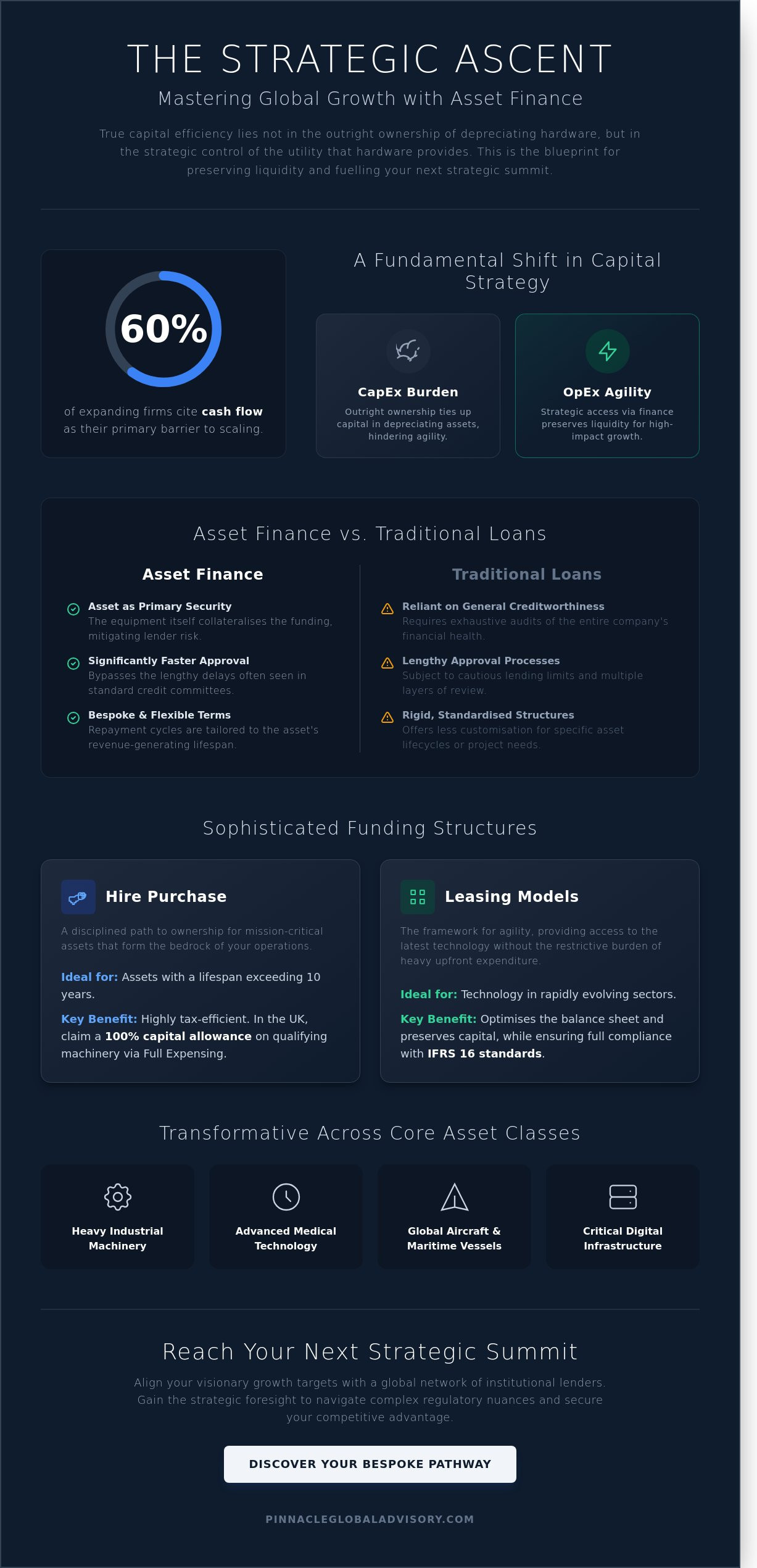
True capital efficiency is rarely found in the outright ownership of depreciating hardware; it lies in the strategic control of the utility that hardware provides. You likely recognise that in the 2024 fiscal environment, where over 60% of expanding firms cite cash flow as their primary barrier to scaling, a poorly structured asset finance arrangement can inadvertently stifle your momentum. It's a common frustration for leaders who find their growth trajectories hampered by the very tools meant to propel them forward. Strategic scaling demands liquidity.
Within this guide, we'll demonstrate how sophisticated funding structures can preserve your liquidity, optimise your balance sheet, and fuel your next strategic summit. We'll examine the deliberate shift from CapEx to OpEx and the Global scaling frameworks required to expand across international borders without compromising your operational cash flow. By aligning your funding structure with your long-term vision, you'll ensure your organisation remains at the pinnacle of its industry while maintaining the flexibility to adapt to rapid technological shifts.
Key Takeaways
Discover why the world’s most agile enterprises are prioritising asset utility over equity to maintain the liquidity necessary for rapid global expansion.
Explore how to leverage sophisticated Hire Purchase and leasing arrangements to optimise your balance sheet while ensuring full compliance with evolving IFRS 16 standards.
Learn how to integrate asset finance into your capital stack to preserve founder control and achieve a more favourable risk-adjusted cost of capital than unsecured alternatives.
Gain the strategic foresight needed to navigate regional regulatory nuances across the UK and Oceania, ensuring your financial modelling is prepared for high-level institutional scrutiny.
Identify the bespoke pathways for aligning your visionary growth targets with a global network of institutional lenders to successfully reach your next strategic summit.
What is Asset Finance? Defining the Strategic Horizon
To master the terrain of modern commerce, one must first recognise that capital is most potent when it remains fluid. At its core, asset finance represents the strategic practice of leveraging the inherent value of physical assets to secure funding or lease essential equipment. This marks a fundamental departure from the traditional fixation on outright ownership; instead, it prioritises the utility of an asset over the equity held within it. This shift allows an enterprise to maintain its momentum without being anchored by illiquid investments that could otherwise hinder its global scaling efforts.
Elite architects of business growth understand that holding depreciating assets on a balance sheet can often stifle a firm's trajectory. By shifting the focus to access, organisations can deploy the latest technology without the restrictive burden of heavy upfront expenditure. This approach is particularly transformative within core asset classes:
Heavy industrial machinery and manufacturing plants
Advanced medical technology and diagnostic suites
Global aircraft fleets and maritime vessels
Critical digital infrastructure and data centres
For the wise strategist, liquidity preservation isn't merely a defensive measure; it's a primary competitive advantage. When capital is unchained from physical hardware, it's available for high-impact R&D, market expansion, or strategic acquisitions. Data from LeaseEurope recently highlighted this shift, noting that new business volumes in the European equipment leasing market grew by 10.4% in 2023, reflecting a distinct global trend toward flexible capital deployment and operational excellence.
The Distinction Between Asset Finance and Traditional Loans
Traditional bank facilities often rely on a company's general creditworthiness, which leads to exhaustive audits and cautious lending limits. Asset-backed structures differ because the asset itself serves as the primary security. This collateralisation naturally mitigates lender risk and facilitates more favourable terms for the borrower. Because the risk is contained, approval speeds are significantly higher; asset-backed structures often bypass the lengthy delays seen in standard credit committees. These arrangements also offer bespoke flexibility, tailoring repayment cycles to the asset's specific revenue-generating lifespan.
Key Terminology for the Global Executive
Navigating this landscape requires a firm grasp of its technical vocabulary. Residual Value is a critical concept, representing the asset's estimated worth at the conclusion of the lease term. This value directly influences the monthly commitment and the overall efficiency of the arrangement. Additionally, leaders must weigh depreciation against potential appreciation; while most machinery loses value, certain specialist assets may retain significant strategic worth. Asset Finance is a sophisticated mechanism for capital agility that empowers organisations to master volatile global markets by prioritising operational access over the constraints of fixed-capital ownership.
Sophisticated Structures: Leasing, Hire Purchase, and SPVs
Asset finance isn't a monolithic product; it's a sophisticated toolkit designed to align your capital expenditure with your long-term strategic vision. Selecting the right architecture for your acquisition is a matter of precision, ensuring that the chosen instrument reflects the specific lifecycle of the asset and the fiscal goals of the organisation. Whether you're scaling a global fleet or commissioning a bespoke production line, the structure you choose defines your trajectory toward the summit of operational excellence.
Hire Purchase: Capitalising on Ownership
For mission-critical assets that represent the bedrock of your operations, hire purchase offers a clear, disciplined path to ownership. Under this structure, you'll typically provide an initial deposit, often including the full VAT amount, though many Global firms now opt for VAT deferral schemes to preserve immediate liquidity. The primary advantage lies in the ability to claim capital allowances immediately. Following the UK's March 2023 budget, the introduction of Full Expensing allows companies to claim a 100% capital allowance on qualifying plant and machinery, making this a highly tax-efficient route for permanent acquisitions. It's the ideal choice for equipment with a lifespan exceeding ten years.
Leasing Models: Flexibility in a Rapidly Evolving Terrain
Leasing provides the agility required to master a terrain defined by rapid technological shifts. Operating leases are particularly effective for assets with high obsolescence risk, such as IT infrastructure or specialised medical equipment. Since you're only paying for the asset's use over a fixed term, you avoid the burden of disposal and the sting of depreciation. Conversely, finance leases offer a different strategic alignment; they appear on the balance sheet under IFRS 16 standards, which were implemented in 2019 to increase transparency. This model ensures you maximise the asset's utility while the lessor retains legal ownership, providing a balanced approach to debt-to-equity ratios. When your team begins evaluating these complex structures, the focus should remain on matching the lease term to your specific technological refresh cycle.
The Architecture of the SPV in Asset Finance
For high-value, transformative projects like aircraft acquisition or large-scale infrastructure, the Special Purpose Vehicle (SPV) serves as the elite architect's preferred tool. By isolating the asset within a ring-fenced legal entity, a Global enterprise can effectively insulate the parent company from project-specific risks. This structure is essential for multi-stakeholder collaborations where debt-to-equity management is paramount. It allows for bespoke financing terms that don't disrupt the primary corporate balance sheet, ensuring that your pursuit of growth doesn't compromise your foundational stability. It's a visionary approach to scaling that prioritises both ambition and discretion.
Asset Finance within the Capital Stack: A Strategic Analysis
Thinking of asset finance as a tool for the struggling is a fundamental misunderstanding of modern capital architecture. Elite firms view it as a surgical instrument for liquidity. When you compare it to unsecured business loans, the risk-adjusted cost of capital is almost always more favourable. Because the loan is secured by a physical asset, lenders offer tighter spreads and more flexible terms. This creates a powerful synergy with invoice finance; while one unlocks the value of your sales ledger, the other maximises the utility of your plant and machinery. It's about strategic foresight, not desperation. By using asset finance, you ensure that your liquid cash remains available for high-yield opportunities rather than being locked away in depreciating hardware.
Equity vs. Asset Finance: The Dilution Debate
Funding long-term growth with equity is often an expensive mistake for established leaders. Using equity to purchase machinery or vehicles means trading away a permanent slice of your company for an asset that will eventually hit a zero-value floor. Opting for debt to fund these items is far more efficient. Imagine a manufacturing firm planning a £5m plant expansion. If they raise that capital through equity, they might sacrifice two board seats and 10% to 15% of their future dividends. If they use asset finance, they retain 100% control while the equipment essentially pays for itself through increased production capacity. By integrating asset-backed debt into the capital structure, a business successfully lowers its Weighted Average Cost of Capital (WACC) by substituting expensive equity with lower-cost, collateralised borrowing.
Integrating Asset Finance into M&A Strategies
Strategic growth often requires a sophisticated approach to acquisitions. Asset-based M&A allows you to use the target company’s own balance sheet to fund a significant portion of the purchase price. You can refinance the target's existing machinery or vehicle fleet to unlock immediate liquidity, which is particularly effective in management buy-outs (MBOs) where capital is often the primary hurdle. This method reduces the need for the acquiring party to provide all the cash upfront. Bespoke debt advisory helps bridge the gap in complex buy-side transactions, ensuring the deal reaches completion without over-leveraging the parent company. It allows for a smoother transition and provides the necessary working capital to hit the ground running from day one of the new ownership.
Strategic Control: Retain board seats and voting rights by avoiding equity rounds for equipment.
Liquidity Management: Use refinancing to pull cash out of existing assets for M&A deposits.
Risk Mitigation: Secure lower interest rates compared to unsecured corporate debt.
Implementation: Navigating the Global Regulatory Terrain
Executing a sophisticated capital strategy requires more than just intent; it demands a mastery of the regulatory climates that define global trade. To reach the summit of capital efficiency, your organisation must view asset finance not as a simple loan, but as a structured instrument that aligns with international reporting standards. Since the implementation of IFRS 16 on 1 January 2019, the distinction between operating and finance leases has largely vanished for lessees. This change brought nearly all leases onto the balance sheet, fundamentally altering debt-to-equity ratios. We help you model these impacts with precision, ensuring your corporate reporting reflects strength rather than leverage.
The UK and Australian Markets: Parallel Paths
For firms operating across the London-Brisbane axis, the tax landscape offers distinct advantages if you know where to look. In the United Kingdom, the permanent "Full Expensing" policy introduced in the 2023 Autumn Statement allows companies to deduct 100% of the cost of qualifying plant and machinery from their taxable profits. This is a powerful successor to the previous Super-Deduction, providing a 25p tax saving for every £1 invested.
In Australia, the landscape is equally nuanced. The Australian Taxation Office (ATO) extended the $20,000 instant asset write-off threshold for small businesses through to 30 June 2025. For larger corporate entities, the focus shifts to strategic depreciation and the optimisation of corporate tax groups. Managing a footprint in both regions requires an Elite Architect who understands how to harmonise these disparate incentives into a single, cohesive global trajectory.
UK Full Expensing: 100% first-year capital allowance for qualifying investments.
Australian Incentives: $20,000 threshold for immediate deductions for eligible entities.
Cross-Border Alignment: Synchronising depreciation schedules to optimise global tax liabilities.
Preparing Your Financials for a Premium Outcome
Lenders at the highest level don't just look at your balance sheet; they scrutinise your operational discipline. Securing a premium rate on asset finance requires independent appraisals that go beyond book value. You need to demonstrate cash flow stability that can withstand market volatility. We approach due diligence with the poise of a Wise Strategist, ensuring every piece of documentation, from asset valuations to five-year projections, is beyond reproach. This level of preparation ensures you aren't just another applicant; you're a high-status partner.
Choosing a global advisory firm over a local broker is the difference between a transaction and a transformation. A broker looks for a commission on a single deal. We look at your entire global portfolio to ensure your financing structures support long-term scaling. If you are ready to elevate your capital structure, it's time to consult with a partner that understands the bespoke global strategy required for true market mastery.
The Pinnacle Approach: Bespoke Solutions for Global Trajectories
Pinnacle Global Advisory functions as the architect of your financial future, ensuring your capital structure reflects the height of your ambition. We recognise that for a firm to scale across borders, it needs more than just a loan; it requires a calibrated instrument of growth. Our Global network bridges the gap between high-growth enterprises and the world's most sophisticated institutional lenders, including private credit funds and tier-one investment banks. This connectivity ensures that capital is sourced from partners who understand the nuances of cross-border operations and the complexities of international tax frameworks.
By integrating asset finance into a broader strategic framework, we transform static equipment or intellectual property into dynamic levers for expansion. We don't just facilitate a transaction. We cultivate a long-term partnership that looks toward secondary market opportunities and the eventual maturity of your debt profile. This foresight ensures that as your business reaches new milestones, your financing remains a tailwind rather than a constraint. It's about creating a sustainable momentum that carries your brand into new territories with confidence.
The Value of Elite Debt Advisory
Standard, off-the-shelf finance packages rarely survive the rigours of rapid international scaling. These rigid structures often fail to account for the seasonal fluctuations or the specific CAPEX requirements of a firm expanding into three or more jurisdictions simultaneously. We focus on structuring bespoke terms that anticipate your future needs, ensuring your debt maturity profile aligns with your projected revenue peaks. This strategic foresight prevents the liquidity crunches that, according to 2023 industry benchmarks, affect nearly 42% of mid-market firms during their first phase of global expansion. We prioritise flexibility, allowing your business to pivot without the restrictive covenants that define traditional lending.
Your Next Strategic Summit
Success at the highest level requires an alignment between your grandest visions and your day-to-day execution. If your current capital structure feels like an anchor rather than an engine, it's time to review your trajectory. We invite you to engage with our team for a comprehensive analysis of your capital stack. We'll help you identify where asset finance can release trapped value and how to position your firm for its next major ascent. The path to market leadership is rarely a straight line, but with the right advisory partner, the destination becomes inevitable. You can Consult with our Global Debt Advisory Team today to begin the process of refining your financial architecture for the global stage.
Architecting Your Global Trajectory
Mastering the terrain of international industry requires more than just operational excellence; it demands a sophisticated approach to capital efficiency. You've seen how asset finance serves as a transformative lever within the capital stack, allowing for the preservation of vital liquidity while securing mission-critical infrastructure. From navigating the regulatory intricacies of global jurisdictions to structuring complex SPVs, the path to the summit is paved with deliberate, high-level decisions.
Our boutique advisory teams, operating from two primary hubs in London and Brisbane, have spent years refining these trajectories for leaders who refuse to settle for transactional mediocrity. We leverage a global network of sophisticated institutional lenders to ensure your vision isn't just funded, but strategically aligned with long-term stability. Whether you're orchestrating a complex M&A or a high-stakes MBO, the right financial architecture makes the difference between a stalled project and a successful global expansion. It's time to view your equipment and technology as the strategic assets they truly are. Your next summit is within reach.
Frequently Asked Questions
What is the difference between asset finance and a standard business loan?
Asset finance is secured specifically against the equipment or vehicle you're acquiring, whereas a standard business loan often relies on general cash flow or a floating charge over your entire organisation. This structural distinction means the lender retains a form of ownership or a primary lien on the specific item until the term concludes. It's an elegant way to preserve working capital while ensuring the equipment pays for itself through operational use.
Can asset finance be used for intangible assets like software or IP?
You can certainly use this funding model for intangible assets such as enterprise software or intellectual property, provided the lender can establish a clear valuation and recovery path. While traditional lenders focus on hard assets like machinery, modern global financiers now facilitate soft asset funding for up to 100% of software implementation costs. This approach allows firms to scale their digital infrastructure without the immediate burden of a heavy capital expenditure.
How does IFRS 16 affect my company's use of asset leasing?
IFRS 16 mandates that almost all leases must be recognised on the balance sheet as a right-of-use asset and a corresponding lease liability. This change, which became effective for reporting periods starting on or after 1 January 2019, eliminates the previous off-balance sheet advantage of operating leases. Companies must now meticulously track these obligations, as they directly influence key financial ratios like debt-to-equity and EBITDA during your global expansion.
Is asset finance available for pre-revenue high-growth startups?
Asset finance is available to pre-revenue startups, though it typically requires strong venture backing or a substantial guarantee from the founders. Lenders often look for a minimum of 12 months of runway or a recent Series A funding round to mitigate the risk of early-stage volatility. By leveraging the asset itself as security, these high-growth firms can acquire the specialised equipment needed to reach their first revenue summit without diluting equity.
What happens to the asset at the end of a finance lease term?
At the end of a finance lease term, you usually have the option to purchase the asset for a nominal fee, return it to the lender, or extend the agreement. Because the total cost of the asset is typically amortised over the primary period, the final purchase option is often set at a predetermined residual value. This flexibility ensures your capital remains aligned with the asset's actual lifecycle and your firm's evolving operational requirements.
How long does it typically take to secure a facility?
Securing a facility generally takes between 48 hours and two weeks, depending on the complexity of the transaction and the clarity of your financial records. For standard equipment, a credit decision is often reached within 24 hours of the initial application. More bespoke arrangements for global scaling or cross-border acquisitions require a deeper level of due diligence, which might extend the trajectory to the 14-day mark.
Can I use this funding model to fund an acquisition or MBO?
You can utilise this strategic lever to fund a management buyout or a corporate acquisition by leveraging the existing unencumbered assets of the target company. This asset-based lending strategy unlocks the latent value in a firm's balance sheet to provide the necessary liquidity for the transaction. It's a sophisticated tool that allows ambitious leaders to scale through acquisition without relying solely on external private equity or high-interest mezzanine debt.
Are there specific tax benefits to asset finance in the UK vs Australia?
The UK offers the Full Expensing policy which allows companies to claim a 100% capital allowance on qualifying plant and machinery investments until 31 March 2026. In contrast, Australia's Instant Asset Write-Off threshold is currently set at $20,000 for small businesses through 30 June 2024. Both jurisdictions provide distinct mechanisms to accelerate tax relief, making it essential to align your global financing strategy with local fiscal regulations and strategic foresight.


Comments