
The Strategic Architecture of Corporate Worth: A Comprehensive Guide to the Valuation of a Company

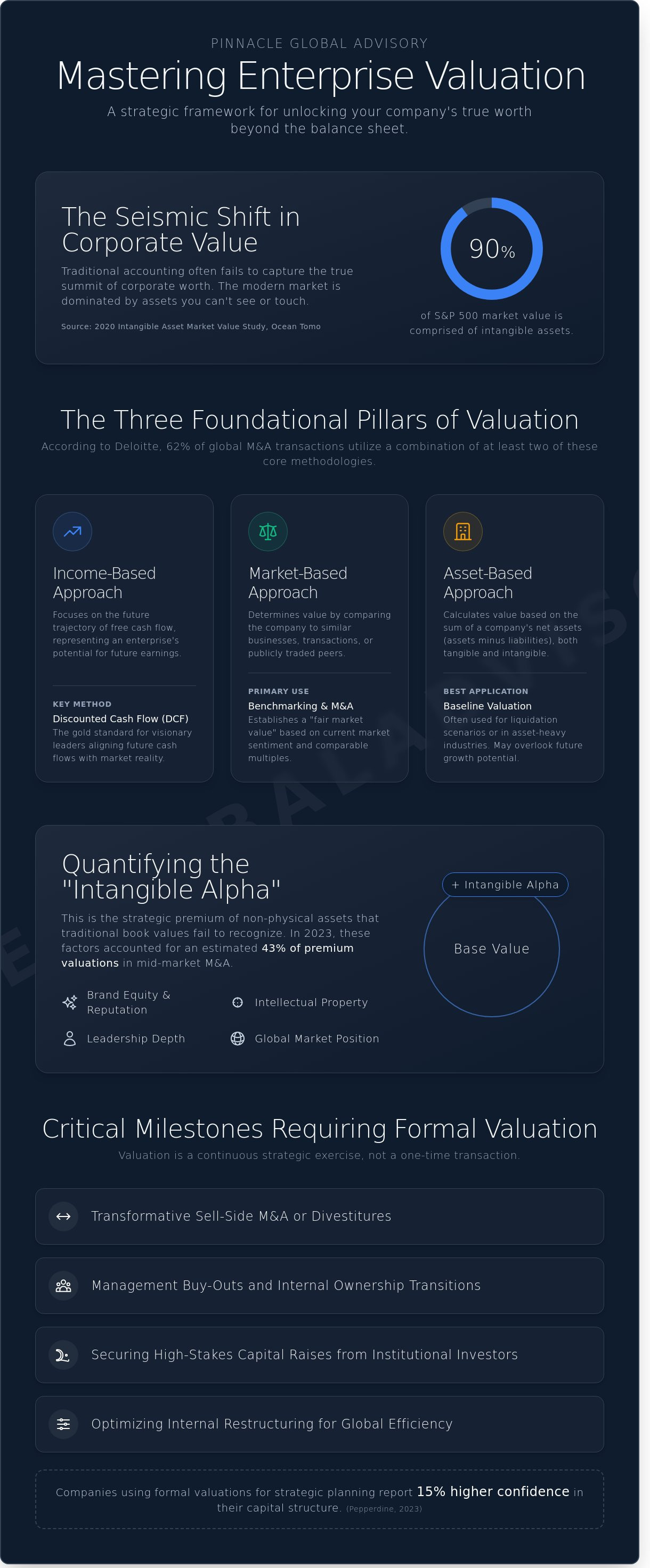
According to the 2020 Intangible Asset Market Value Study by Ocean Tomo, intangible assets have ascended to represent 90% of the total market value within the S&P 500. This seismic shift away from physical holdings suggests that traditional accounting often fails to capture the true summit of corporate worth. You likely recognize that the valuation of a company remains an intricate terrain where conflicting methodologies and global market volatility often cloud the path to a definitive figure. It's common to feel a sense of unease that your brand's intellectual capital or strategic positioning is being overlooked by standard metrics during high-stakes evaluations.
Pinnacle Global Advisory provides the strategic foresight necessary to master these sophisticated frameworks, allowing you to determine and elevate your organization's market premium with quiet assurance. We'll guide you through a bespoke Global framework for calculating enterprise value while bridging the persistent gap between historical book value and modern market expectations. This exploration serves as a definitive briefing for leaders preparing for a transformative M&A or a secondary market transaction, ensuring every pillar of your success is expertly articulated and aligned with your long-term trajectory.
Key Takeaways
Analyse the three foundational pillars of valuation-Income, Market, and Asset-based approaches-to identify the sophisticated frameworks that define true enterprise worth.
Learn to quantify the "Intangible Alpha," capturing the strategic premium of brand equity and intellectual property that traditional book values often fail to recognise.
Master the art of optimizing the valuation of a company by implementing a rigorous 18-month preparation phase and transitioning toward strategic financial reporting.
Discover why the Discounted Cash Flow (DCF) model remains the gold standard for visionary leaders seeking to align future cash flow trajectories with market reality.
Understand the transformative role of a Global Strategic Advisor in navigating complex market terrains to bridge the gap between current state and pinnacle value.
The Strategic Essence of Company Valuation: Beyond the Balance Sheet
Determining the true valuation of a company transcends the mere aggregation of historical ledger entries; it's a sophisticated synthesis of current economic realities and long-term strategic foresight. While a balance sheet offers a retrospective glimpse into past performance, a pinnacle valuation focuses on the future trajectory of free cash flow. This forward-looking perspective distinguishes an elite enterprise from its peers. To reach a definitive conclusion, advisors must navigate the nuanced differences between fair market value, which assumes a hypothetical willing buyer, and investment value, which accounts for the specific synergies a particular acquirer brings to the table. Intrinsic value remains the most disciplined metric, representing the value based purely on fundamental analysis without the distortion of temporary market fluctuations.
The specific purpose of the assessment dictates the choice of methodology. A capital raise for a high-growth technology firm requires a different lens than a legacy industrial merger. When a leader seeks to understand the valuation of a company, they aren't just looking for a number; they're seeking a strategic roadmap that aligns their current operational excellence with their long-term global ambitions.
The Art and Science of Professional Appraisal
Professional appraisal demands a rigorous equilibrium between quantitative modelling and qualitative strategic alignment. While Business valuation methodologies provide the mathematical framework, market sentiment often dictates the final summit price. In 2023, global M&A activity saw a shift where qualitative factors, such as intellectual property and leadership depth, accounted for approximately 43% of premium valuations in the mid-market sector. Bespoke advisory services outperform generic online calculators because they interpret these intangibles within the context of global market shifts. A calculator doesn't sense the quiet assurance of a disciplined management team or the transformative potential of a proprietary algorithm. It's the difference between a simple estimate and a global strategic briefing.
When Does a Company Require a Formal Valuation?
Formal assessments become indispensable during critical liquidity events and structural transitions. Leaders require these insights when preparing for sell-side M&A or management buy-outs (MBOs), where every basis point of accuracy impacts the final exit. Internal restructuring or the creation of secondary market liquidity for shareholders also necessitates a transparent, defensible figure. Beyond transactions, strategic growth planning relies on benchmarking against global peers. According to the 2023 Pepperdine Private Capital Markets Report, companies that utilize formal valuations for strategic planning report 15% higher levels of confidence in their capital structure. The valuation of a company serves as a baseline for several key milestones:
Executing transformative sell-side M&A or divestitures.
Facilitating management buy-outs and internal ownership transitions.
Securing high-stakes capital raises from institutional investors.
Optimizing internal restructuring for global tax and operational efficiency.
Benchmarking performance against industry leaders to identify growth gaps.
By treating valuation as a continuous strategic exercise rather than a one-time transaction, executives maintain a constant alignment between their vision and their market reality.
Primary Methodologies for Determining Enterprise Value
Determining the precise valuation of a company requires a synthesis of quantitative rigor and strategic foresight. While the process is often viewed through a lens of pure mathematics, it is truly an exercise in architectural precision; every financial model serves as a pillar supporting the weight of a firm’s future trajectory. Most sophisticated advisors rely on three distinct frameworks to establish a credible range of value: the Income, Market, and Asset-based approaches. According to a 2023 report by Deloitte, 62% of global M&A transactions utilised a combination of at least two of these methodologies to ensure a balanced perspective on worth.
The Income Approach: Capturing Future Potential
The Income Approach, specifically the Discounted Cash Flow (DCF) model, remains the gold standard for organisations with predictable, long-term growth. This method calculates the present value of all expected future earnings, adjusting them for the time value of money and risk. To achieve an accurate result, we must determine the Weighted Average Cost of Capital (WACC), which acts as the discount rate reflecting a firm's Global risk profile. A critical component here is the "Terminal Value," which often accounts for more than 70% of the total valuation in high-growth sectors. It represents the value of the business beyond the initial 5 or 10-year forecast period, assuming a steady state of operational excellence. Understanding the nuances of company valuation methods is essential for leaders who wish to articulate their brand’s long-term promise to sophisticated investors.
The Market Approach: Real-Time Competitive Benchmarking
Market-based valuation shifts the focus from internal projections to external reality, utilising real-time data to find market alignment. By analysing EV/EBITDA and P/E ratios of comparable companies, we can benchmark a firm’s performance against industry leaders. This isn't a simple comparison; it requires a bespoke adjustment for size, growth rates, and geographic reach. In a globalised economy, selecting the right "peers" is vital. For instance, a mid-cap tech firm in 2024 might command a higher premium if its operational efficiency exceeds the industry average by even 3% or 4%. This method ensures that the valuation of a company stays rooted in the current appetite of the Global capital markets.
While the Income and Market approaches look forward and outward, the Asset-based approach provides a necessary floor, particularly in capital-intensive industries like manufacturing or infrastructure. It focuses on the fair market value of a firm’s net assets, ensuring that the valuation never dips below its intrinsic liquidation or replacement cost. For leaders seeking to refine their Global strategic foresight, aligning these three methodologies is the only way to reach the summit of corporate clarity. This disciplined approach transforms raw data into a narrative of inevitable growth and stability.
The Intangible Alpha: Valuing Intellectual Property and Market Position
While tangible assets provide a floor for pricing, the true valuation of a company in the current era is defined by its intangible alpha. Historical data from 1975 showed that nearly 83% of corporate value was tied to physical property; however, a 2020 analysis by Ocean Tomo revealed that intangibles now command 90% of the S&P 500's total market capitalisation. This shift demands a more sophisticated lens than simple book value provides. Elite firms look beyond the balance sheet to quantify a strategic premium, which includes the alignment of brand equity, proprietary systems, and the specialised knowledge of human capital. Standard company valuation methods provide the foundation, but they must be refined to account for the transformative impact of Global operational excellence and ESG compliance. Investors now view environmental and social governance not merely as a moral choice, but as a critical risk-mitigation factor that directly influences the discount rate applied to future cash flows.
A company’s domicile and its Global reach also dictate its risk-adjusted worth. A firm operating across 50 countries faces different geopolitical headwinds than a domestic entity, yet its diversified revenue streams often justify a higher multiple. This geographic mastery creates a trajectory toward the valuation summit that less expansive competitors cannot replicate. When leadership teams demonstrate a clear vision for international scaling, they effectively lower their cost of equity by proving resilience against localised economic downturns.
Architecting Value Through Intellectual Property
Proprietary software and patents represent the structural steel of a modern enterprise's valuation. To quantify these bespoke assets, advisors often employ the Relief from Royalty method, which estimates the costs saved by owning the IP rather than licensing it from a third party. This approach, combined with a rigorous assessment of legal defensibility, ensures that the valuation of a company reflects its true innovative capacity. Protecting this summit requires constant strategic foresight; the expiration of a key patent or a breach in trademark security can lead to a 20% to 30% contraction in market premium almost overnight.
The Network Effect and Market Dominance
Market dominance is rarely about size alone; it's about the "moat" built through customer stickiness and recurring revenue. SaaS models have revolutionised valuation multiples because they offer predictable, scalable growth that traditional manufacturing models lack. When a Global partnership network aligns with a high-retention product, the resulting network effect creates a self-sustaining cycle of value creation. These strategic alliances act as accelerators, pushing a firm’s valuation trajectory higher by reducing acquisition costs and increasing the lifetime value of the client base.
Optimising Your Trajectory: Preparing a Business for Premium Valuation
Achieving a premium valuation of a company requires a deliberate, multi-year ascent rather than a last-minute scramble. Sophisticated investors don't just buy historical performance; they're acquiring a future trajectory. Data from the Exit Planning Institute indicates that approximately 70% of private businesses fail to sell because of inadequate preparation. We recommend an 18-month lead time to refine operational efficiency and financial clarity. This window allows leadership to transition from statutory auditing, which merely satisfies compliance, to Global Strategic Reporting. This shift provides the granular insights necessary to justify a higher multiple during the negotiation phase.
Financial and Operational Alignment
Maximising the valuation of a company necessitates a pristine balance sheet and optimised working capital. We focus on eliminating "owner-dependent" value traps by building management depth that ensures the enterprise thrives independently of its founder. EBITDA add-backs serve as a critical mechanism for normalising earnings by neutralising non-recurring expenses or discretionary costs that don't reflect core operational profitability. Our Global Advisory teams emphasise these pillars to ensure the business presents as a turnkey asset:
Working Capital Optimization: Reducing the cash conversion cycle to demonstrate superior liquidity.
Management Redundancy: Establishing a C-suite capable of executing the Global Strategic Vision without founder intervention.
Revenue Quality: Shifting toward recurring revenue models that command a 20% to 30% premium in most sectors.
The Due Diligence Ready Mindset
Preparation is a signal of corporate excellence. A virtual data room (VDR) shouldn't be a cluttered digital drawer; it's a curated narrative of your firm's success. According to a 2023 Bain & Company report, deal timelines have extended by 30% due to increased scrutiny. We pre-empt these objections through proactive strategic growth advisory, ensuring that every secondary market transaction and intellectual property filing is documented and aligned with the overarching corporate structure. This level of foresight transforms due diligence from a hurdle into a confirmation of value.
To inspire sophisticated investors, you must articulate a "Strategic Growth Narrative" that maps out the next five years of expansion. It's not enough to show where you've been. You must demonstrate the summit you're prepared to reach. By aligning your current operational excellence with a visionary roadmap, you position your business as a bespoke opportunity rather than a mere commodity. Success isn't found in the transaction; it's found in the preparation that precedes it.
Prepare your business for the global stage and secure the premium your legacy deserves. Contact Pinnacle Global Advisory for a bespoke valuation assessment.
Navigating the Global Market: How Strategic Advisory Elevates Valuation Outcomes
The distinction between a transactional broker and a Global Strategic Advisor defines the distance between a standard exit and a landmark achievement. Brokers typically operate within a narrow scope; they focus on immediate buyer lists and standard industry multiples. Conversely, a Global Strategic Advisor views the valuation of a company as a dynamic baseline rather than a fixed ceiling. This approach involves a rigorous refinement of the corporate narrative to ensure the business resonates with high-level institutional interests across international borders.
Pinnacle Global Advisory bridges the gap between your current operational state and your peak market value. By identifying hidden synergies and optimising internal structures, we position firms to attract the Strategic Acquirer. These buyers, often international conglomerates, view an acquisition through the lens of long-term integration and market dominance. Data from 2023 industry reports indicates that strategic buyers consistently pay premiums 25% higher than traditional financial investors. This Global perspective transforms the sale from a mere exchange of assets into a deliberate ascent to the summit of your industry.
Bespoke Solutions for Complex Transitions
Managing the valuation of a company during a Management Buy-Out (MBO) or a secondary market transition requires a sophisticated hand. We customise the strategic narrative to align the interests of diverse stakeholders, from internal leadership to external private equity partners. This alignment ensures a seamless transition where the momentum of the business remains uncompromised. Our Global Debt and Equity Advisory services provide access to over 500 institutional capital sources, ensuring the capital structure is as robust as the vision it supports.
Securing Your Legacy at the Pinnacle
The selection of a strategic partner remains the most critical variable in any high-stakes transaction. Success isn't found in the first offer; it's found in the offer that recognises the full weight of your professional legacy. To move beyond standard benchmarks and realise the true potential of your enterprise, Engage with Pinnacle Global Advisory. We provide the strategic foresight needed to master the terrain of international M&A and secure a transformative exit. The ultimate valuation is the one that achieves the founder’s vision.
Mastering Your Corporate Legacy
Determining the true worth of an enterprise requires a lens that extends far beyond the immediate balance sheet. Success in the current 2024 fiscal landscape hinges on the strategic alignment of intangible assets and the precise application of methodologies that reflect global shifts. By focusing on intellectual property and market positioning, leaders can secure a trajectory toward a premium exit. The valuation of a company isn't a static figure; it's a dynamic narrative of potential and operational excellence that demands a sophisticated approach.
Pinnacle Global Advisory brings strategic foresight to every engagement. With a proven track record in complex M&A and secondary market transactions across the UK, Europe, and Oceania, our team offers the depth required for high-stakes decisions. We guide C-suite executives through the nuances of the global landscape to ensure every summit is reached with precision. Your legacy deserves a partner who understands the intricate architecture of success.
Architect your exit with Pinnacle Global Advisory and secure your place at the peak of industry leadership.
Frequently Asked Questions
What is the difference between Enterprise Value and Equity Value?
Enterprise Value represents the total operational worth of a business, encompassing both debt and equity, while Equity Value reflects only the portion attributable to shareholders. To calculate the total valuation of a company, analysts often start with Enterprise Value and subtract net debt. This distinction is vital during Global M&A negotiations where the 2023 average debt-to-equity ratio in the S&P 500 reached 1.5, significantly altering final purchase prices for stakeholders.
How do you value a private company with no comparable public peers?
When public benchmarks are unavailable, advisors utilise the First Chicago Method or a bespoke Discounted Cash Flow analysis to determine the valuation of a company. This approach combines three distinct scenarios: a best-case, mid-case, and worst-case outcome. By assigning a 25 percent probability to the high-growth summit scenario, leaders can navigate the terrain of uncertainty with a data-driven trajectory that doesn't rely on external market volatility or public sector fluctuations.
Can a company be valued highly if it is not yet profitable?
Unprofitable entities achieve high valuations by demonstrating a clear trajectory toward operational excellence and a massive addressable market. In 2024, high-growth technology firms often trade at revenue multiples between 5x and 12x despite negative earnings. Investors prioritise the strategic foresight of the leadership team and the scalability of the business model; they view current losses as a necessary investment in future market dominance and long-term value creation.
How does an MBO (Management Buy-Out) affect the valuation process?
A Management Buy-Out typically introduces a unique dynamic where the internal leadership team's intimate knowledge of the operational terrain influences the final price. While external acquisitions might command a 30 percent control premium, MBO valuations often align more closely with fair market value to avoid conflicts of interest. This Global strategy requires a meticulous independent appraisal to ensure the transaction withstands the scrutiny of minority shareholders and regulatory bodies during the transition.
What role do secondary market transactions play in business valuation?
Secondary market transactions serve as a critical barometer for the valuation of a company by establishing a liquidity-driven price point for private equity. In 2023, the secondary market volume reached 112 billion dollars, providing a tangible data point for firms that haven't yet reached their IPO summit. These trades offer a baseline that reflects current investor sentiment, allowing for a more accurate alignment between internal projections and external market realities in the private sector.
How often should a high-growth company undergo a formal valuation?
High-growth enterprises should undergo a formal Global valuation review every 12 months or immediately following a Series B or C funding round. Maintaining this cadence ensures that the strategic narrative remains in sync with the actual financial performance. This discipline prevents the misalignment of expectations during sudden exit opportunities, especially given that 40 percent of mid-market firms fail to capture full value due to outdated financial records or stagnant data.
What are the most common mistakes founders make during the valuation process?
Founders frequently err by prioritising vanity metrics over the rigorous Discounted Cash Flow models that sophisticated investors demand. A 2022 survey indicated that 15 percent of startups fail to account for their weighted average cost of capital, leading to inflated expectations. True mastery of the valuation process requires a focus on sustainable cash flow and the elimination of aggressive pro-forma adjustments that obscure the underlying health of the corporate structure.
How do global economic shifts in 2026 impact corporate valuation multiples?
Projections for 2026 suggest that Global interest rate stabilisation will lead to a compression of EBITDA multiples by approximately 12 percent across the manufacturing sector. As the economic landscape shifts, leaders must employ transformative strategies to protect their firm's trajectory. Strategic foresight suggests that firms with high operational efficiency will maintain their premium status, even as the broader market experiences a cooling of valuations compared to the peaks seen in late 2021.


Comments