
Debt Finance for Business Acquisition: 2026 Framework

What if the primary constraint on your next acquisition isn't the availability of capital, but the sophistication of the debt structure used to secure it? As the value of UK mergers and acquisitions nearly tripled to £292 billion in the first half of 2026, the mastery of debt financing for business acquisition has become the definitive differentiator between market participants and industry leaders. You're likely aware that while the appetite for expansion is significant, the current 3.75% Bank of England base rate requires a level of fiscal precision that traditional lending models often fail to provide.
We understand the hesitation that comes with managing a volatile interest rate environment and the desire to avoid over-leveraging your future. This 2026 framework promises to guide you through the architecture of sophisticated debt structures and capital solutions designed to preserve your equity whilst accelerating corporate growth. Drawing upon extensive international experience, we shall examine the evolving global lender landscape, the rise of private credit, and how to secure favourable lending terms through the Growth Guarantee Scheme. By the end of this briefing, you'll possess the confidence to lead high-stakes corporate transitions with a bespoke capital structure that aligns perfectly with your visionary goals.
The Strategic Landscape of Debt Financing in 2026 Acquisitions
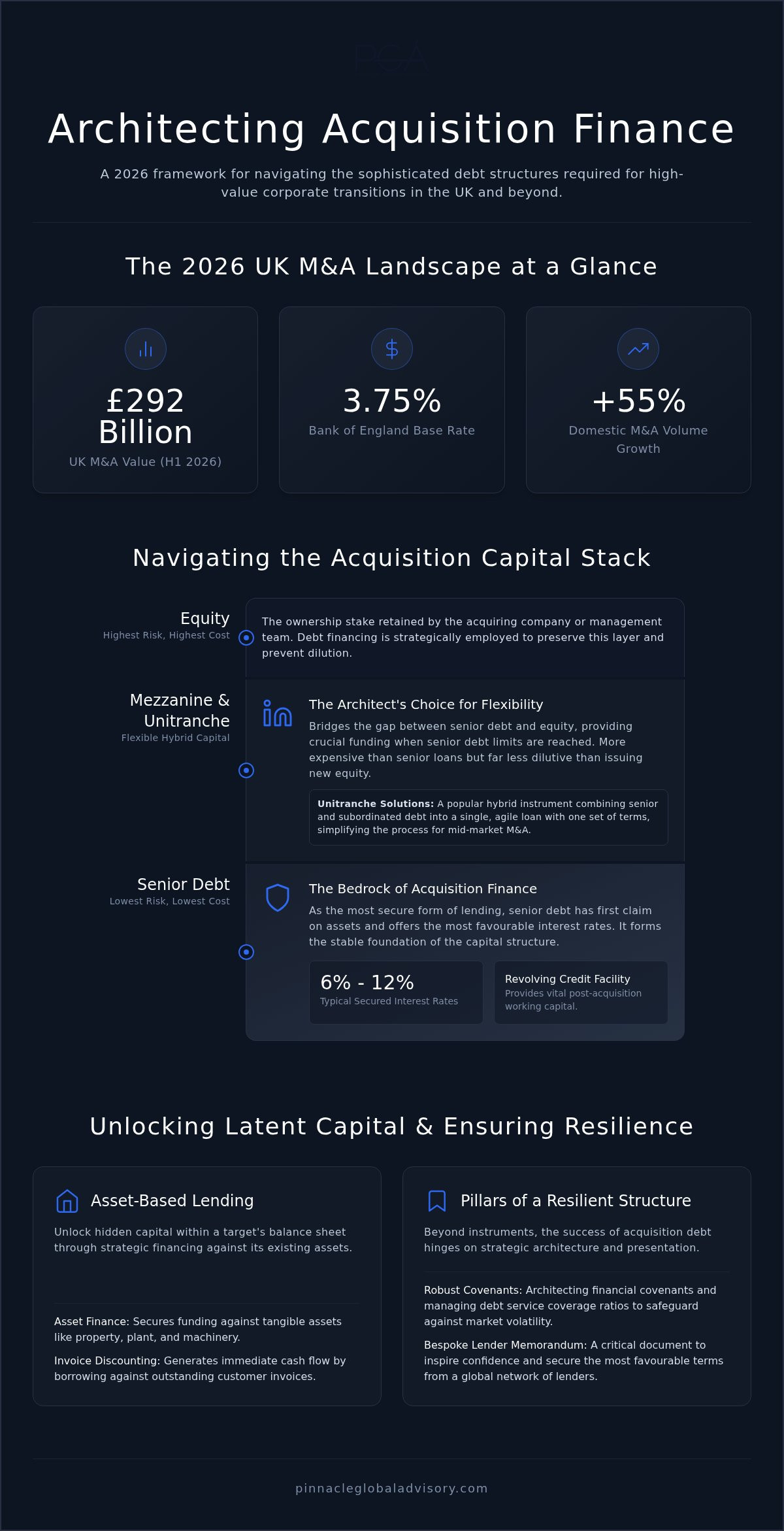
In the current climate, debt is no longer a mere transactional necessity; it's a sophisticated lever for capital efficiency. With UK M&A deal values nearly tripling to £292 billion in the first half of 2026, the demand for high-level debt financing for business acquisition has reached a zenith. High-status executive leaders recognise that the path to market dominance isn't paved with equity alone. It requires a disciplined approach to the capital stack that prioritises long-term stability over quick fixes. This shift reflects a broader movement within the buy-side m&a advisory lifecycle, where the focus has moved from simple procurement to the strategic architecting of growth.
Debt as a Catalyst for Growth and Equity Preservation
The 'Leverage Effect' remains a cornerstone of corporate excellence. By utilising disciplined borrowing, an organisation can significantly enhance its return on equity whilst maintaining absolute control over its strategic direction. The challenge lies in balancing the cost of capital, currently influenced by the 3.75% Bank of England base rate, against the transformative potential of the target entity. Acquisition debt is the rhythmic synchronisation of vision and capital. When structured correctly, it allows firms to scale at a pace that would be impossible through organic cash flow or dilutive equity rounds alone. It's about ensuring that every borrowed pound acts as a multiplier for shareholder value.
Navigating the Difficult Landscapes of Modern Corporate Finance
The primary objection many boards face is the fear of over-leveraging in a market that feels increasingly volatile. It's a valid concern. However, the 2026 lending environment has evolved. We've moved away from the era of rigid, one-size-fits-all bank terms toward bespoke capital solutions that honour the nuances of each transaction. Traditional, off-the-shelf bank loans frequently fail to meet the needs of complex corporate transitions. They lack the flexibility required for post-acquisition integration and often impose restrictive covenants that stifle innovation. Securing the right debt financing for business acquisition requires a visionary partner who understands the global lender landscape. In a world of high-stakes transitions, the right debt structure isn't just a financial arrangement; it's a strategic foundation for inevitable growth.
The Rise of Private Credit and the Role of the Government Growth Scheme
Two developments have reshaped the acquisition lending market, and they operate at opposite ends of the deal spectrum. At the upper mid-market, private credit has moved from alternative to default. Unitranche now accounts for the substantial majority of new private credit issuance in the UK mid-market, with direct lenders pricing in the region of SONIA plus 550 to 800 basis points and leverage commonly settling between four and six times EBITDA. The advantage is rarely the headline rate. It's certainty and cadence: a direct lender can move from term sheet to completion in four to six weeks, where a syndicated process may take eight to twelve and carry flex provisions that allow pricing to widen mid-flight. For a bidder in a competitive process, that execution confidence is often worth the premium - though it should be weighed against tighter enforcement rights and a concentrated creditor relationship rather than a diversified bank club.
At the lower end, the Growth Guarantee Scheme provides a different kind of leverage. Administered by the British Business Bank, it gives accredited lenders a 70% government-backed guarantee, improving credit appetite for borrowers who would otherwise struggle to secure terms. In July 2026 the Chancellor announced a further £6.5bn of lending capacity over four years, alongside facility terms extending to ten years for term loans and asset finance and a rise in the turnover eligibility threshold from £45m to £54m. With facilities generally capped at £2m per business group, GGS will seldom fund the acquisition itself on a mid-market transaction - but it is frequently the most efficient way to structure the working capital, asset finance or invoice finance layer sitting alongside the senior facility, freeing conventional headroom for the purchase price. Two points warrant discipline: the guarantee protects the lender, not you, so the borrower remains liable for 100% of the debt; and cumulative subsidy limits apply, which must be assessed early in any debt financing for business acquisition structure rather than discovered at credit committee.
Sophisticated Debt Instruments: Navigating the Capital Stack
The architecture of a high-value acquisition relies on a meticulously constructed capital stack. Whilst many smaller ventures rely on basic term loans, sophisticated leaders utilise a layered approach to debt financing for business acquisition to optimise their weighted average cost of capital. This requires a deep understanding of how different instruments interact; moving from the secure foundation of senior debt to the flexible heights of mezzanine finance. Each layer serves a specific strategic purpose, ensuring the acquisition is both funded and sustainable over the long term.
Senior Term Loans and Revolving Credit Facilities
Senior debt serves as the bedrock of the acquisition capital structure. Because senior lenders demand the first claim on assets, this layer typically offers the most favourable interest rates, which currently range between 6% and 12% for secured loans in the UK. We don't just look for the lowest rate. We focus on structuring repayment profiles that align with the target's cash flow seasonality. A well-designed senior facility ensures that debt service remains manageable during leaner months. Additionally, incorporating a revolving credit facility provides the essential working capital needed to fund post-acquisition growth initiatives without further diluting ownership.
Mezzanine and Unitranche: The Architect's Choice for Flexibility
When senior debt reaches its leverage limits, mezzanine finance bridges the gap to the equity layer. Although more expensive than senior debt, its cost is often far lower than the long-term price of equity dilution. For mid-market enterprises, unitranche solutions have become increasingly popular. These hybrid structures combine senior and subordinated debt into a single instrument with one interest rate and one set of covenants. Structuring debt financing for business acquisition through a unitranche model can provide the agility needed to outpace competitors in high-stakes transitions, particularly as domestic M&A volumes grew by 55% in early 2026.
In management buy-outs (MBOs), subordinated debt often plays a critical role in satisfying the vendor's price expectations whilst keeping the management team's equity stake meaningful. Successfully navigating the inter-creditor agreements amongst these various tiers requires a partner with a global perspective. If you're looking to refine your capital structure, our debt advisory specialists can help you navigate these complex global lender landscapes. Every instrument must be chosen with precision to ensure the final structure supports your overarching vision of corporate excellence. The goal is a steady cadence of growth that feels expertly managed and secure.
Leveraging Internal Value: Asset-Based Finance and Invoice Discounting
One of the most underutilised strategies in high-stakes M&A is the extraction of value from the target’s own balance sheet. Whilst traditional term loans focus on future cash flow, asset-based lending (ABL) prioritises the tangible and intangible assets already in place. This approach provides a robust floor for acquisition valuations, ensuring that the debt financing for business acquisition is grounded in existing substance. It's a method favoured by seasoned strategists who seek to maximise leverage without over-extending the parent company's credit facilities.
Asset Finance as a Strategic Growth Foundation
UK businesses currently utilise asset finance to acquire over £35 billion of equipment annually. In industrial or tech-heavy acquisitions, plant, machinery, and intellectual property represent significant pools of latent capital. By financing these assets directly, you can substantially reduce day-one cash requirements. Sale and leaseback structures offer a particularly elegant solution; they allow the acquiring entity to unlock capital from the target’s existing assets to fund the purchase price itself. This remains a preferred route for mid-market deals across the UK and the European Union, where asset density is often high and valuations are underpinned by physical infrastructure.
Invoice Discounting and Factoring in M&A
Accelerating cash flow through the target’s accounts receivable ledger is another hallmark of sophisticated execution. High-quality debtor books are often the most liquid assets available during a transition. When you integrate invoice finance into the broader debt financing for business acquisition strategy, you bridge the gap between completion and the realisation of post-acquisition synergies. Discretion is paramount here. We prioritise confidential invoice discounting to ensure that customer relationships remain undisturbed during the sensitive period of corporate restructuring. It’s about maintaining a steady cadence of operations whilst the broader strategic vision is implemented. By leveraging the target's high-quality debtor book, you turn passive balance sheet items into active engines of growth.
Architecting the Capital Structure: Covenants and Risk Mitigation
Architecting a robust capital structure requires more than just securing funds; it involves the meticulous design of financial covenants that act as the guardrails for your enterprise's future. When negotiating debt financing for business acquisition, executive leaders must maintain a steady focus on the Debt Service Coverage Ratio (DSCR) and Net Debt/EBITDA multiples. These metrics aren't merely administrative requirements. They are the vital signs of your post-acquisition health. For high-performing enterprises with strong cash flow visibility, there is often an opportunity to negotiate 'covenant-lite' structures. These arrangements provide the operational freedom necessary to pursue bold strategic pivots without the constant friction of rigid lender oversight.
Normalising EBITDA for Debt Capacity Analysis
Before a lender commits to a facility, they'll scrutinise the target's earnings with clinical precision. This is where the true debt-servicing potential is revealed. We focus on identifying legitimate add-backs, adjusting for one-off costs and non-recurring corporate transitions that might otherwise mask the target's underlying profitability. The role of buy-side m&a advisory is critical during this financial 'scrubbing' phase. By presenting a normalised EBITDA that reflects the future state of the business, you can often unlock significantly higher leverage levels whilst maintaining the confidence of your credit partners. It's about ensuring the narrative of the numbers aligns with the ambition of the deal.
Mitigating Interest Rate and Market Risks
In an environment where the Bank of England base rate sits at 3.75% as of August 2026, interest rate hedging has become a non-negotiable component of strategic stability. Effective risk management ensures that rhythmic market fluctuations don't jeopardise your long-term objectives. Beyond interest rates, lenders in 2026 are increasingly prioritising ESG compliance as a prerequisite for favourable terms. Aligning your acquisition strategy with sustainable outcomes isn't just a moral imperative; it's a financial one. Across recent mid-market transactions, we see that firms with high ESG scores often benefit from tighter spreads and more flexible repayment windows. If you're ready to design a capital structure that protects your vision, our strategic debt advisors can architect a solution tailored to your specific risk profile.
Securing Optimal Terms: The Value of Sophisticated Debt Advisory
Securing the most favourable terms in a competitive market requires more than just a strong balance sheet; it demands the presence of a seasoned strategist who can articulate your vision to the global lender landscape. Whilst traditional brokers often focus on transactional speed, a boutique advisory firm prioritises the long-term strategic fit. The cornerstone of this process is the architecting of a 'Lender Memorandum'. This document isn't a mere summary of accounts. It's a sophisticated blueprint that inspires confidence by synchronising your operational goals with the lender's risk appetite. By presenting a poised, professional narrative, you ensure that your request for debt financing for business acquisition stands out amongst the high volume of deals currently saturating the UK market.
The Advisor as a Strategic Architect
Pinnacle Global Advisory functions as a master designer of corporate success, orchestrating the entire debt lifecycle from initial conception to final execution. We don't just find lenders; we curate a global network of sophisticated investors who understand the nuances of international business. In high-stakes negotiations, having a high-status peer by your side changes the dynamic of the conversation. It moves the discussion away from rigid bank terms toward bespoke solutions that honour your equity and your ambition. This level of professional representation is essential when navigating the complexities of inter-creditor agreements or when seeking the flexibility of unitranche structures mentioned earlier in our framework. Our role is to ensure that the debt financing for business acquisition you secure today doesn't become a constraint on your growth tomorrow.
Executing the Acquisition with Mastery
Closing a deal of this magnitude requires disciplined oversight during the final stages of fund disbursement. The transition from the Letter of Intent (LOI) to the final transfer of capital is a delicate period where operational stability must be maintained. We ensure that every covenant is aligned and every risk mitigation strategy is in place before day one. Once the acquisition is finalised, the journey doesn't end. The transition from debt raising to long-term strategic growth advisory is where the true value of a visionary partnership is realised. We remain committed to the pursuit of perfection, ensuring that your new capital structure supports a steady cadence of inevitable growth. Enlist Pinnacle Global Advisory to architect your acquisition debt strategy.
Architecting Your Path to Corporate Excellence
Mastering the complexities of debt financing for business acquisition requires more than just capital; it demands a visionary approach to the capital stack. We've explored how a sophisticated blend of senior debt, mezzanine finance, and asset-based solutions can preserve your equity whilst providing the fuel for transformative growth. By architecting robust financial covenants and normalising EBITDA with clinical precision, you ensure your organisation's built on a foundation of long-term stability rather than temporary leverage. The transition from a simple acquisition to a market-leading enterprise is a difficult landscape best navigated with a poised and worldly partner.
As strategic architects for complex corporate transitions, Pinnacle Global Advisory offers global access to sophisticated debt and equity markets. Our bespoke UK executive focus provides the international reach necessary to secure optimal terms that honour your unique strategic goals. We invite you to partner with Pinnacle for expert debt advisory and take the first step toward reaching the highest levels of your industry. With the right structure in place, your next acquisition won't just be a transaction; it'll be a masterclass in corporate excellence. We look forward to guiding your vision toward its inevitable peak.
Frequently Asked Questions
What is the most effective debt financing structure for a business acquisition?
The most effective structure typically involves a meticulously layered capital stack that balances the low cost of senior debt with the flexibility of mezzanine finance or unitranche solutions. By synchronising these instruments with the target's cash flow profile, an organisation can maximise leverage whilst preserving equity. For mid-market deals, a unitranche model is often preferred as it simplifies the inter-creditor landscape and provides the agility required for rapid post-acquisition integration.
How much debt can I safely take on to fund an acquisition?
Safe leverage is determined by your Debt Service Coverage Ratio (DSCR) and Net Debt to EBITDA multiples. Most sophisticated lenders look for a DSCR that ensures interest and principal repayments are comfortably covered by normalised operating cash flow. Whilst specific ratios vary by industry, maintaining a disciplined approach to debt financing for business acquisition ensures that your organisation remains resilient against market fluctuations, such as changes to the Bank of England base rate.
What is the difference between senior debt and mezzanine finance?
Senior debt sits at the foundation of the capital stack and carries the first claim on the target company's assets, resulting in lower interest rates. Mezzanine finance is a hybrid instrument that sits between senior debt and equity. It's typically unsecured and carries a higher cost, but it provides the necessary bridge to fund high-value acquisitions without the significant equity dilution associated with bringing in new shareholders or private equity partners.
How do lenders determine interest rates for business acquisitions in 2026?
In 2026, lenders determine rates by adding a risk-based margin to the Bank of England base rate, which is currently 3.75%. This margin is influenced by the target's sector, the strength of the management team, and increasingly, the organisation's ESG compliance. For established businesses, secured loan APRs typically range from 6% to 12%, whilst unsecured options for SMEs may reach up to 15%, reflecting the lender's assessment of long-term strategic stability.
Can I use the target company's assets to finance the purchase?
You can unlock capital directly from the target company's balance sheet through asset-based lending or sale and leaseback structures. By leveraging tangible assets such as plant, machinery, or a high-quality debtor book, you can significantly reduce the initial cash requirement for the transaction. This strategy provides a floor for acquisition valuations and is particularly effective in industrial or tech-heavy sectors where physical or intellectual property holds substantial latent value.
What are the typical financial covenants required by UK lenders?
UK lenders typically impose financial covenants such as minimum Debt Service Coverage Ratios, maximum Net Debt to EBITDA multiples, and minimum liquidity requirements. These guardrails ensure that the borrower maintains a specific level of financial health throughout the loan term. For high-performing enterprises, it's possible to negotiate 'covenant-lite' structures that offer greater operational freedom, though these usually require a visionary partner to present a compelling strategic narrative to the lender.
Why is a debt advisory firm necessary for an M&A transaction?
A debt advisory firm acts as a strategic architect, navigating the complex global lender landscape to secure terms that honour your long-term objectives. Beyond simple procurement, they craft a sophisticated 'Lender Memorandum' that inspires confidence and ensures your request for debt financing for business acquisition stands out. Their expertise in inter-creditor agreements and capital structuring is essential for executing high-stakes transitions whilst avoiding the rigid terms that often stifle post-acquisition growth.
How does a Management Buy-Out (MBO) impact debt financing options?
In an MBO, the existing management team's intimate knowledge of the business acts as a significant risk mitigant for lenders. This often opens doors to more flexible financing options, including vendor loan notes or subordinated debt, which bridge the gap between senior facilities and management equity. Because the leaders are already embedded in the organisation, lenders may offer more favourable terms, provided the capital structure is designed to support inevitable growth and stability.

Comments