
How to Value a Company With No Revenue: A Strategic Guide for Visionary Leaders

In the sophisticated world of international finance, a balance sheet devoid of earnings is not a void of value; it's a canvas for strategic architecture. Whilst traditionalists may falter when EBITDA multiples are absent, visionary leaders recognise that the true worth of a pre-revenue enterprise lies in the disciplined synchronisation of proprietary technology and market potential. You likely feel the weight of investor scepticism when attempting to quantify the intangible brilliance of your intellectual property or explain how to value a company with no revenue. With one in four European venture rounds recently recorded as down rounds, the stakes for establishing a defensible, premium valuation have never been higher for those seeking capital raising or M&A positioning.
This guide provides the sophisticated frameworks you need to master these methodologies, ensuring your narrative remains authoritative and your valuation remains intact. By adopting the same rigorous logic used in elite international boardrooms, you'll learn to architect a valuation report that commands respect from even the most seasoned institutional partners. We will examine the critical transition from pre-revenue status to market validation, providing a clear roadmap to transform your strategic vision into a tangible asset that's ready for superior execution and sustainable growth.
Key Takeaways
Learn to transition from a historical performance mindset to a strategic potential model by mastering specialised frameworks such as the Berkus Method and Scorecard Valuation.
Discover how to value a company with no revenue by quantifying the defensive strength of your intellectual property and establishing a clear first-mover advantage in global sectors.
Understand how to benchmark your enterprise against current market dynamics whilst accurately distinguishing between Total Addressable Market and Serviceable Obtainable Market.
Architect a compelling Information Memorandum that transforms your vision into a defensible asset ready for the rigours of professional due diligence.
Gain the authoritative perspective required to negotiate a premium valuation during high-stakes equity capital raising or M&A transactions.
The Challenge of Valuing the Invisible: Why Revenue Isn't Always King
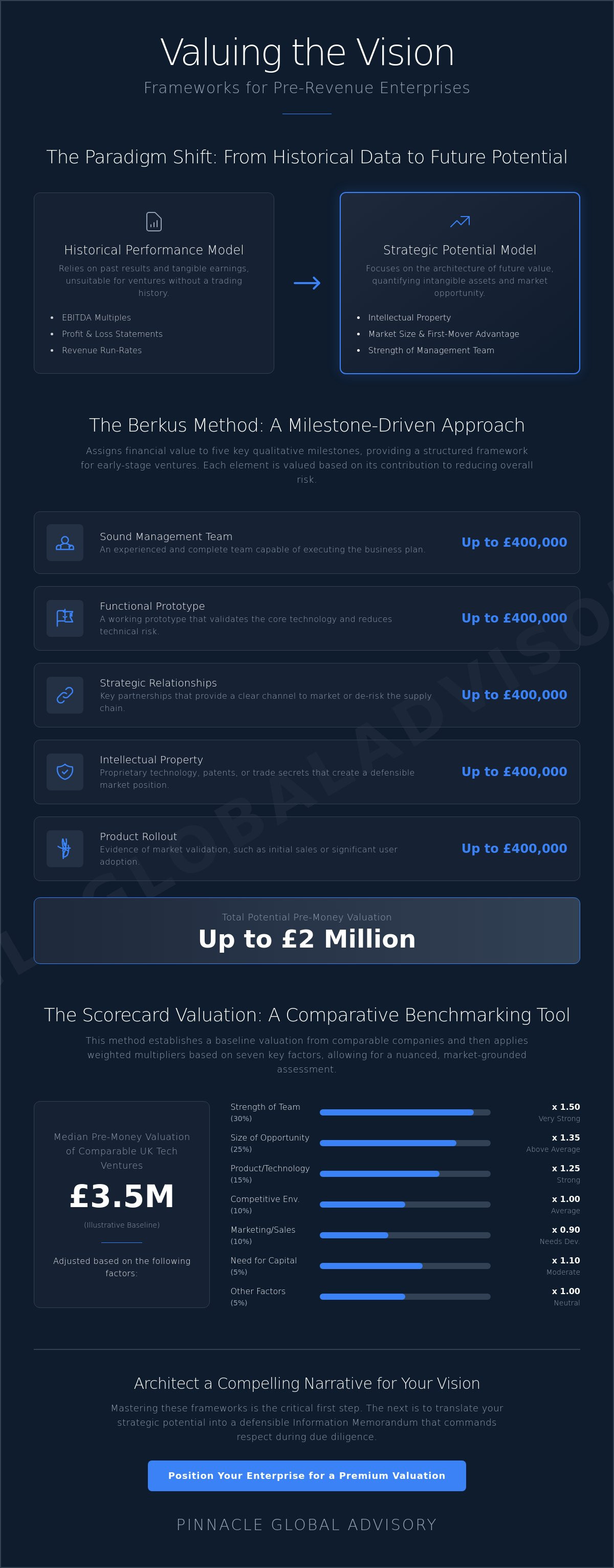
Within the high-stakes environment of corporate finance, the absence of a top-line figure is often misinterpreted as an absence of substance. However, for the seasoned strategist, pre-revenue valuation is not a retrospective audit but a forward-looking assessment of future cash flow potential. Whilst the 'Historical Performance' model relies on the comfort of past results, the 'Strategic Potential' model demands a more sophisticated architecture. It requires an understanding of how to value a company with no revenue by examining the underlying assets that will eventually command market share. Understanding how to value a company with no revenue is about mapping the path to market dominance rather than merely counting existing receipts.
This shift in perspective is particularly critical in three distinct environments:
R&D-heavy deep technology: Where the value resides in patent-protected innovation and long-term defensibility rather than immediate sales.
Pre-launch SaaS platforms: Where the focus is on ecosystem building and the potential for rapid, scalable user acquisition.
Strategic corporate spin-offs: Where an established entity carves out a high-growth division to unlock hidden value, leveraging the parent's existing infrastructure.
The Shift from EBITDA to Strategic Worth
Traditional business valuation approaches often lean heavily on EBITDA multiples; yet, these metrics are fundamentally ill-suited for enterprises in their formative stages. Without a profit and loss statement, value is derived from 'Option Value', the strategic right to exploit a future market opportunity. Sophisticated investors in the UK and Australia frequently prioritise 'land-grab' potential over immediate yield, recognising that a dominant market position today is worth far more than marginal profits tomorrow. In these high-growth corporate environments, revenue acts merely as a floor. It's the vision and the defensibility of your intellectual property that provide the valuation ceiling.
Risk vs Reward in the Pre-Revenue Landscape
Success is a balance between execution risk and market risk. For visionary leaders, the primary lever is 'Time to Revenue' (TTR). A shorter TTR reduces the capital required to reach sustainability, whilst a longer horizon requires a more robust narrative to justify the investment. Managing investor expectations during a capital raising journey involves a disciplined focus on milestones rather than just the final destination. Considering that in early 2024, almost one in four European venture rounds were down rounds, the necessity for a defensible valuation has never been more acute. By quantifying these risks across international markets, you can architect a valuation that is both ambitious and grounded in commercial reality.
Sophisticated Methodologies for Pre-Revenue Corporate Valuation
Whilst identifying strategic potential is essential, the transition to a defensible report requires the application of rigorous, proven frameworks. Understanding how to value a company with no revenue necessitates a move away from speculative guesswork toward structured judgement. One of the most enduring models is the Berkus Method, which assigns specific financial weight to five key milestones: sound management, a functional prototype, strategic relationships, product rollout, and intellectual property. According to verified benchmarks for 2026, each milestone can be valued at up to $500,000, creating a maximum pre-money valuation of $2.5 million for the earliest-stage ventures. This methodical approach ensures that every element of the organisation's foundation is accounted for with professional precision.
The Berkus and Scorecard Frameworks
Beyond the Berkus Method, the Scorecard Valuation offers a more nuanced benchmarking tool by comparing the enterprise against similar transactions in specific hubs like London or Sydney. This method adjusts a median valuation based on factors such as the strength of the management team and the competitive environment. For those navigating the complexities of strategic growth advisory, these adjustments are vital. They allow leaders to justify a premium by highlighting superior execution capabilities. Additionally, the Risk Factor Summation method provides a further layer of granularity, adjusting the base value across 12 distinct corporate risk categories, including litigation, political climate, and manufacturing capacity.
Advanced Financial Modelling: DCF and Venture Capital Methods
For enterprises with a clearer line of sight to market entry, more traditional company valuation methods can be adapted for pre-revenue contexts. The Venture Capital (VC) method remains a staple for institutional investors, who typically require returns of 10x to 30x on their investment. This model works backwards from an expected exit price, applying a high discount rate to account for the radical uncertainty inherent in pre-revenue stages. Similarly, a Discounted Cash Flow (DCF) analysis can be constructed using multi-year projections. Whilst these projections require strategic credibility, the focus often shifts to the 'Terminal Value', which represents the company's worth at the end of the forecast period. By meticulously calculating the capital required to recreate the asset from scratch, the Cost-to-Duplicate approach provides a final, asset-based floor, ensuring the final figure is both ambitious and logically sound. Mastering these techniques is the cornerstone of knowing how to value a company with no revenue whilst maintaining the confidence of sophisticated global partners.
Architecting Value Through Intellectual Property and Intangibles
In the absence of a ledger filled with transactions, the weight of a pre-revenue enterprise is carried by its intangible foundations. For those determining how to value a company with no revenue, the focus must shift from the 'what' of current earnings to the 'how' of future defensibility. This is where the concept of the 'moat' becomes paramount. A robust intellectual property (IP) portfolio, consisting of patents, proprietary algorithms, and trade secrets, acts as a structural barrier that protects future cash flows from competitive erosion. In emerging global sectors, such as AI infrastructure or green energy, the first-mover advantage isn't merely a timing benefit; it's a measurable asset that establishes market dominance before a single pound of sterling is exchanged.
Whilst traditional pre-revenue valuation methods provide the framework, the quality of the IP determines the scale of the outcome. Beyond the technology itself, the strategic worth of human capital cannot be overstated. Elite technical and executive talent are the architects of execution. Their presence reduces the perceived risk for investors, thereby acting as a defensive buffer for the valuation whilst ensuring the brand's market positioning remains unassailable.
Defensibility: The Core of Pre-Revenue Worth
A well-constructed IP portfolio significantly lowers the 'Risk Factor' within the summation models discussed earlier. For UK-based firms, achieving regulatory milestones, such as approvals from the Medicines and Healthcare products Regulatory Agency (MHRA), serves as a massive value inflection point. These approvals represent a 'Barrier to Entry' that justifies a premium valuation, as they demonstrate that the most difficult landscapes of compliance have already been successfully navigated. This level of defensibility is what separates a speculative venture from a sophisticated corporate asset.
The Strategic Importance of Market Data and User Traction
In modern corporate finance, the debate between user growth and immediate revenue continues to evolve. For high-cap-ex infrastructure or SaaS projects, 'Beta' results and 'Proof of Concept' milestones provide the empirical evidence that the market desires the solution. These non-financial KPIs are the bedrock upon which successful equity capital raising is built. Investors are increasingly looking for 'Pre-validation' rather than just 'Pre-revenue'. By presenting a narrative of inevitable growth supported by user traction, you move the conversation from speculative estimation to strategic execution. This shift is essential for any leader mastering how to value a company with no revenue in today's demanding international market.
Market Dynamics: Benchmarking Potential in a Global Economy
The valuation of a pre-revenue enterprise does not occur in a vacuum; it is deeply influenced by the gravity of the global market and the prevailing appetite for risk. When executive leaders explore how to value a company with no revenue, they must look beyond their own prototype to the macro-economic environment that dictates capital flow. The current M&A cycle plays a decisive role in this process, as exit multiples are often tethered to the sentiment surrounding high-growth sectors. For instance, whilst AI infrastructure and supply chain automation are currently receiving the strongest valuation multiples, traditional retail and low-margin distribution face significant downward pressure. Benchmarking your organisation against recent buy-side m&a advisory transactions provides a grounded reality check against theoretical models, ensuring your strategic narrative aligns with actual market liquidity.
The Role of TAM in Architecting the Narrative
To architect a valuation that commands respect, one must meticulously differentiate between the Total Addressable Market (TAM) and the Serviceable Obtainable Market (SOM). A multi-billion pound TAM provides the visionary ceiling, but the SOM demonstrates the strategic focus and operational discipline of the management team. Validating these figures through independent research is vital to differentiate between transient market noise and genuine strategic demand. In 2026, seed-stage benchmarks suggest that valuations with a lead institutional investor average between $8 million and $12 million pre-money, provided there is a clear path to market validation. Without such backing, valuations more commonly reside in the $1 million to $4 million range, highlighting the necessity of a data-driven market narrative.
Global Perspective: UK, EU, and Australian Market Nuances
Whilst the overarching principles of finance remain constant, the application of these principles varies across the UK, the European Union, and Australia. In the UK market, tax incentives such as the Seed Enterprise Investment Scheme (SEIS) and Enterprise Investment Scheme (EIS) play a pivotal role in investor logic, often providing a structural advantage that encourages higher entry valuations. Navigating these cross-border challenges is essential for those involved in secondary market transactions, where liquidity and local regulatory frameworks intersect. Understanding these nuances is a core component of knowing how to value a company with no revenue whilst maintaining an authoritative stance during international negotiations.
Sector-specific hype cycles can often distort traditional metrics, leading to inflated expectations that may not survive the rigours of professional due diligence. A seasoned strategist recognises that these peaks are temporary and seeks to align a valuation with long-term stability whilst capitalising on current market momentum. By synchronising your vision with the realities of the global economy, you ensure that your enterprise is positioned not just for a transaction, but for a legacy of superior execution.
The Pinnacle Approach: Positioning for a Premium Exit or Capital Raise
The final stage of the strategic journey is the transition from theoretical estimation to rigorous execution. Mastering how to value a company with no revenue is only half the battle; the other half is defending that value in the heat of high-stakes negotiations with institutional partners. This requires a shift in focus toward the Information Memorandum (IM), a document that serves as a sophisticated blueprint for future growth. An IM doesn't just list technical assets; it architects a narrative of inevitable success, ensuring that potential partners see the enterprise not for what it lacks today, but for what it's destined to dominate tomorrow. This synchronisation of vision and financial mastery is what transforms a speculative pitch into a premium corporate offering.
Preparation for Due Diligence
A meticulously organised data room is the silent partner in any successful transaction. When addressing the primary investor objection regarding a lack of historical data, the defence must be rooted in strategic evidence rather than mere optimism. By providing granular detail on pilot programmes, letters of intent, and technical milestones, you transform the 'pre-revenue' label into a state of 'pre-launch validation'. This level of preparation ensures the narrative remains poised and visionary, even under the most intense scrutiny from institutional analysts in the London or Sydney markets. It's about proving that the difficult landscapes of development have been navigated and the summit is within reach.
Partnering for Strategic Excellence
Navigating this complex landscape requires more than just a spreadsheet; it demands an elite partner who understands the nuances of international markets. At Pinnacle Global Advisory, we specialise in Equity Capital Raising and Sell-Side M&A Advisory, ensuring your strategic worth is recognised by the right audience. Our role is to act as a high-status peer to the leaders we advise, connecting high-growth enterprises in the UK, EU, and Australia with a global network of sophisticated investors. We help you close the gap between current valuation and future potential by providing the disciplined guidance necessary for superior execution.
Closing the gap between where you are and where you intend to be requires a mastery of how to value a company with no revenue whilst maintaining the confidence of global stakeholders. Engaging an elite partner to navigate these corporate complexities isn't just a tactical move; it's a commitment to reaching the pinnacle of your industry. By choosing a partner who values long-term thinking and the pursuit of perfection, you ensure that your strategic narrative is not just heard, but acted upon by the world's most sophisticated capital providers.
Architecting the Summit of Corporate Value
Establishing a premium valuation for a pre-revenue enterprise is a deliberate act of strategic design rather than a simple mathematical discovery. By mastering the nuances of intellectual property defensibility and benchmarking against global market dynamics, you move beyond the limitations of historical data to reveal the true worth of your vision. Understanding how to value a company with no revenue allows you to command the attention of the world's most disciplined capital providers. It ensures that your organisation is positioned not merely as a venture, but as a high-altitude asset ready for superior execution and market dominance.
Navigating the complexities of international finance requires a partner who possesses both the expansive reach and the seasoned discipline to synchronise your vision with market reality. With a global network of sophisticated investors and deep expertise in complex M&A and MBO transitions, we provide the strategic growth solutions necessary to reach your highest corporate goals. Architect your corporate future with Pinnacle Global Advisory and transform your visionary potential into a defensible legacy of success. The path to the pinnacle of your industry is yours to define.
Frequently Asked Questions
Can you really value a company with zero revenue?
Yes, valuing a pre-revenue entity is a standard practice in corporate finance, often described as an exercise in structured judgment under radical uncertainty. Rather than relying on historical earnings, the process focuses on the intrinsic economic value of the strategic vision and future cash flow potential. This allows visionary leaders to architect a defensible narrative that prioritises market opportunity and execution capability over the current absence of revenue.
What is the most common method for valuing a pre-revenue startup in the UK?
The Scorecard Valuation and the Berkus Method are the most frequent frameworks used for early-stage companies in the UK. These methodologies allow founders to benchmark their organisation against similar transactions in London whilst assigning value to non-financial assets like management and intellectual property. For institutional rounds, the Venture Capital method is preferred, as it calculates a current valuation based on a required 10x to 30x return at exit.
How do patents and intellectual property affect a company's valuation?
Intellectual property and patents serve as a critical defensive moat that protects future cash flows from competitive erosion. By establishing a clear barrier to entry, a robust IP portfolio reduces the perceived risk factor in sophisticated valuation models. This often allows leaders to justify a higher valuation ceiling during high-stakes negotiations, as the proprietary technology becomes a measurable asset that ensures long-term market defensibility.
Why do pre-revenue companies often have higher valuations than revenue-generating ones?
Pre-revenue companies often command higher valuations because their potential isn't yet constrained by the reality of current performance metrics. Investors pay a premium for 'option value' and the right to exploit a massive future market before it becomes saturated. This 'land-grab' potential is why understanding how to value a company with no revenue is essential for maintaining strategic leverage before earnings begin to set a definitive cap on growth.
What role does the management team play in a pre-revenue valuation?
The management team acts as a primary driver of value by directly reducing the perceived execution risk of the enterprise. Under frameworks like the Berkus Method, a sound leadership team can account for a significant portion of the total pre-money valuation. Elite talent provides the confidence that the strategic vision can be successfully operationalised and navigated through the complexities of the international market, making it a vital non-financial asset.
How can I increase my company's valuation before our first sale?
You can increase your valuation by securing 'pre-validation' through paid pilots, early customer interest, or formal letters of intent. Moving from a speculative status to a pre-validated one significantly lowers the risk for investors and institutional partners. Demonstrating progress toward regulatory milestones, such as MHRA approvals in the UK, also serves as a major value inflection point that justifies a premium before the first sale is ever recorded.
What is a 'Cost-to-Duplicate' valuation and when should it be used?
A Cost-to-Duplicate valuation calculates the total capital and effort required to recreate the company’s assets and technology from scratch. It's typically used as an asset-based floor to ensure the valuation doesn't fall below the literal cost of development. This approach provides a logically sound foundation during initial discussions on how to value a company with no revenue by quantifying the tangible investment and human capital already deployed.
How do market conditions in the EU and Australia impact pre-revenue multiples?
Market conditions in the EU and Australia directly influence investor appetite and the availability of capital for pre-revenue enterprises. In early 2024, almost one in four European venture rounds were down rounds, which has intensified the focus on financial discipline and evidence of traction. Whilst Australian and EU investors are increasingly demanding, local tax incentives like the SEIS and EIS schemes in the UK continue to support early-stage valuation premiums.

Comments